
Deliberatio
Reason through difficult moral decisions under ethical uncertainty.
When people talk about difficult decisions, they usually assume the difficulty comes from a lack of information. We need another report, another expert opinion, another conversation or simply more time. Sometimes that's true. Many decisions become straightforward once the facts are clearer. But some of the most important decisions in our lives remain difficult even when the facts are largely settled.
Should you keep a promise if breaking it would prevent greater harm? Should you take a highly paid job if you believe the company has a negative impact on society? Should you donate to the charity that does the most measurable good, or support a cause that matters deeply to your local community?
In cases like these, the uncertainty is often not empirical but moral. We know what is. We are struggling with what ought to be done.
Over the years, I found myself increasingly uncomfortable with how I approached these decisions. Like most people, I would read different philosophical traditions, find valuable insights in several of them, and then somehow arrive at a single conclusion. Looking back, I realised I was often switching ethical frameworks without noticing and not consciously examining many of my decisions. Sometimes I focused on consequences. Other times I would (unconsciously) appeal to duties, rights or virtues.
If I genuinely believed there was a reasonable chance that more than one moral theory captured something important about ethics, then surely all of them should influence my decisions. Pretending certainty simply because a decision had to be made didn't seem intellectually honest.
Discovering moral uncertainty
This led me to the literature on moral uncertainty, particularly the work of Will MacAskill, Krister Bykvist and Toby Ord. The central idea is remarkably intuitive. If you're uncertain which moral theory is correct, your decisions should reflect that uncertainty rather than ignoring it. Instead of committing completely to one framework, you assign credence to the theories you consider plausible and allow each to contribute to the final judgement. Reading about the idea was (relatively) easy. Applying it consistently wasn't.
I found holding the whole decision process in my head challenging and I couldn't find software that helped me reason this way. There were countless decision matrices and productivity tools, but they all assumed I'd already decided what counted as the right criterion. None helped me navigate uncertainty about the criteria themselves. So I built one.
What Deliberatio does
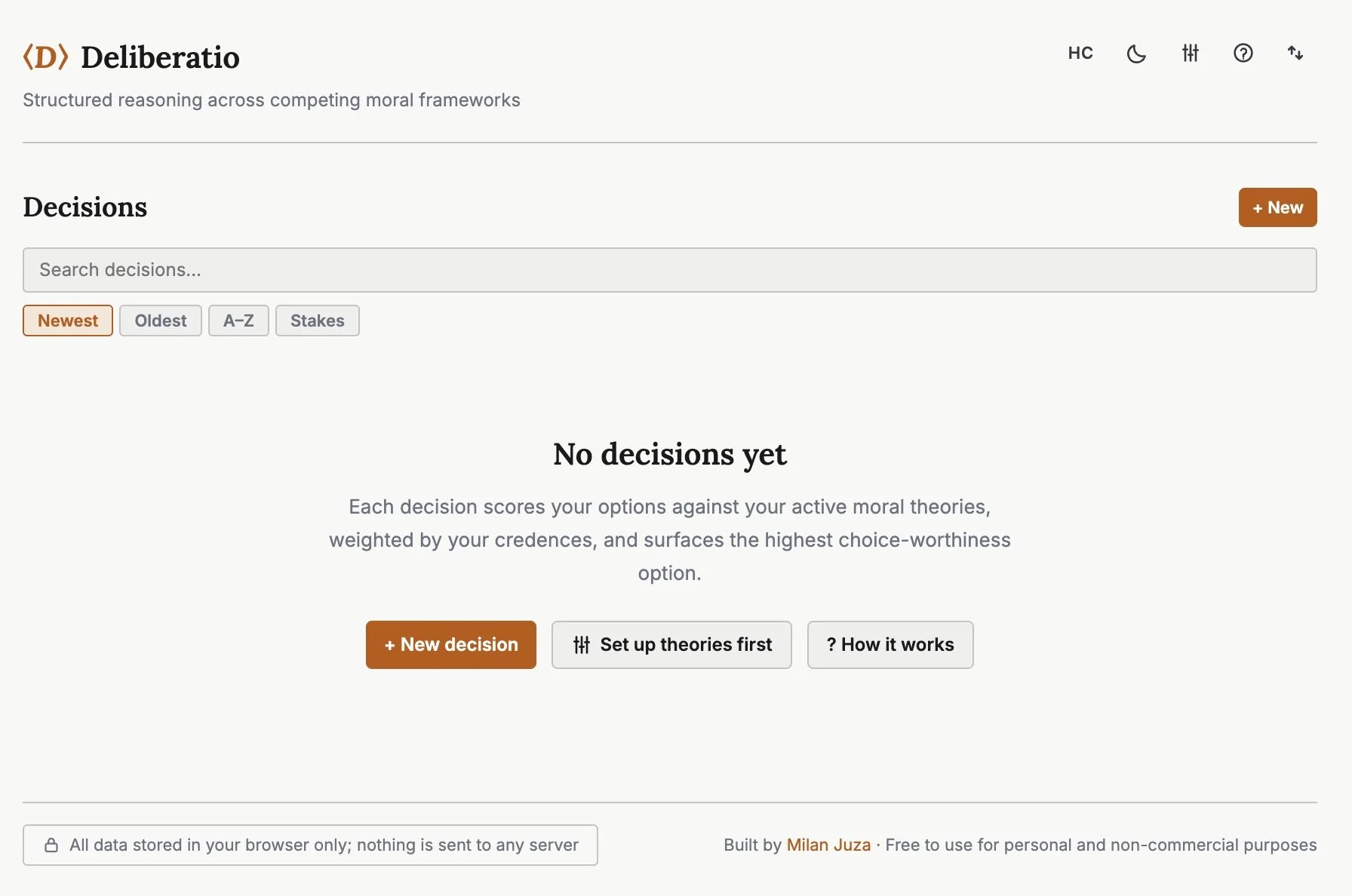
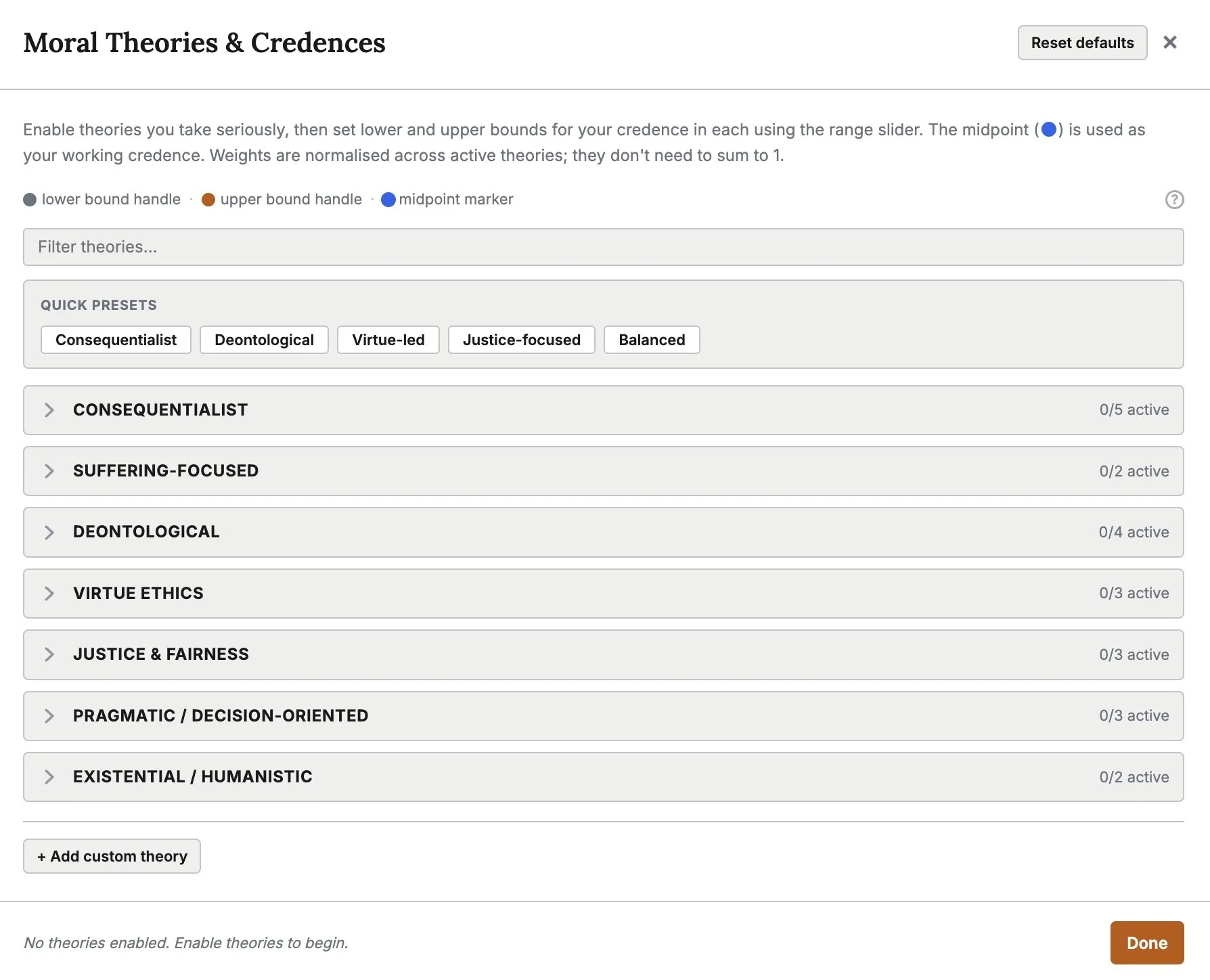
Deliberatio is a decision-support tool built around moral uncertainty. Rather than asking you for a single intuitive judgement, it guides you through a structured process. First, you select the ethical theories you genuinely take seriously. The application includes twenty-two built-in theories covering consequentialism, deontology, virtue ethics, justice, suffering-focused ethics and several other traditions, but you're free to add your own.
Next, you assign a credence range to each theory. I deliberately chose ranges rather than single percentages because our uncertainty is often imprecise. Saying "I'm somewhere between 20% and 40% confident" is frequently a more honest reflection of our beliefs than claiming to know you're exactly 31% confident.
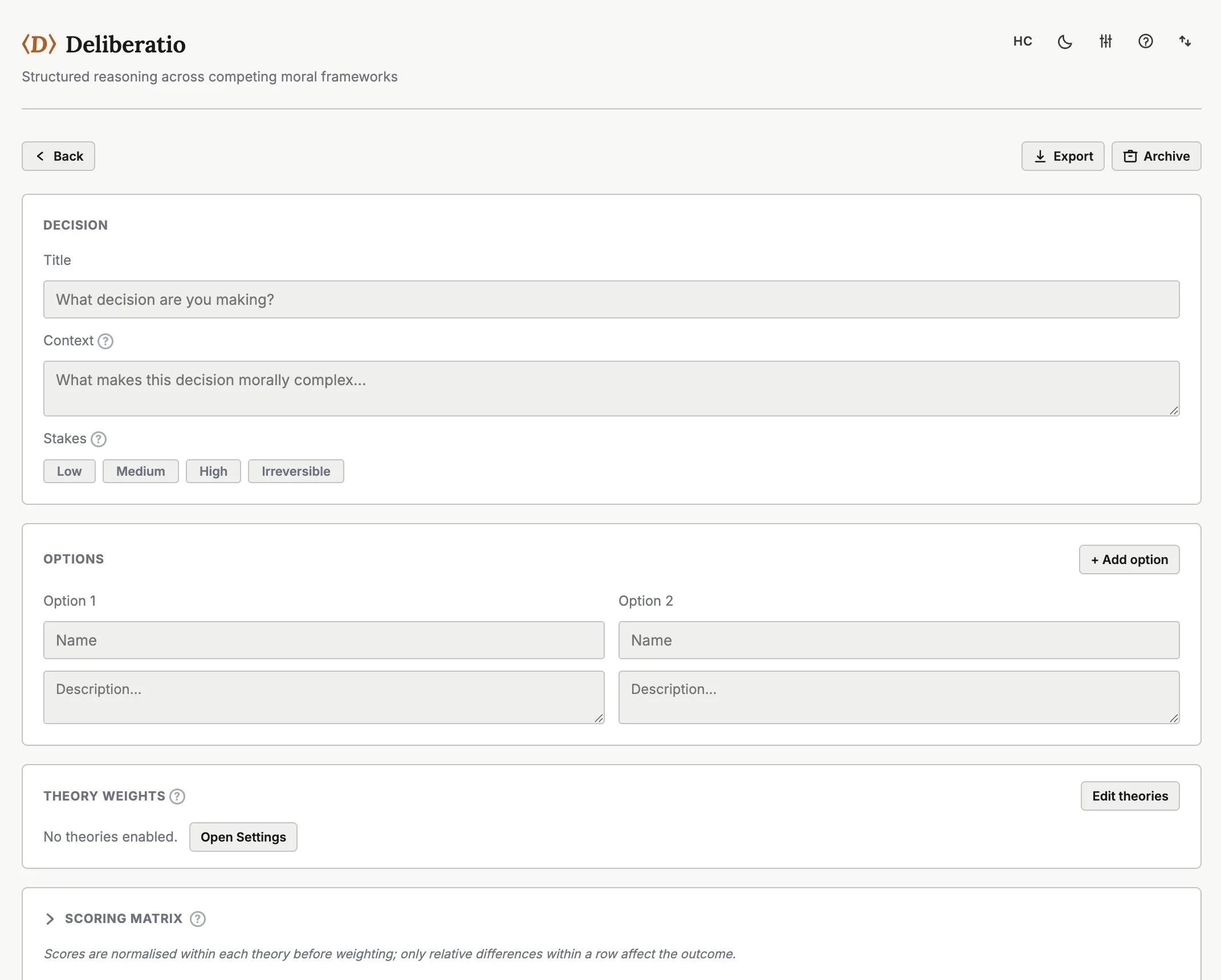
Once that's done, you evaluate every available option under every selected theory.
This is where the application becomes interesting.
Instead of asking whether Option A is better than Option B overall, Deliberatio repeatedly asks narrower questions. If consequentialism were correct, which option would you prefer? If Kantian ethics were correct? If virtue ethics were correct? By isolating each framework, it becomes much harder to unconsciously blend them together.
Only after every assessment has been completed does the application calculate an overall recommendation using Will MacAskill's Maximising Expected Choice-Worthiness framework.
Just as importantly, it shows why that recommendation emerged. Every theory's contribution is visible. Every score can be inspected. Nothing is hidden behind a black box.
Designing against human biases
Many of Deliberatio's features exist because of problems I encountered while building it. One example is anchoring. If people can reveal partial results while they are still entering scores, they inevitably begin adjusting later scores in response to the emerging ranking. Sometimes this happens consciously. More often, it doesn't. To reduce that bias, Deliberatio keeps the recommendation hidden until meaningful scoring has been completed. You commit to your evaluations before seeing where they lead.
Another example is transparency.
Decision-support software often produces a final score without making the reasoning obvious. I wanted the opposite. Every recommendation should be traceable back to the assumptions that generated it. If you disagree with the outcome, you should be able to identify exactly which moral theory or score is responsible. The objective is to make moral reasoning easier to examine.
A tool for thinking
Deliberatio won't tell you what is morally right. No software can resolve philosophical disagreements that have persisted for centuries.
What it can do is encourage a more disciplined way of thinking. It asks you to make your assumptions explicit, apply them consistently and preserve the reasoning behind your decisions so you can revisit them later. For me, that alone has been valuable. The process often changes how I think about a decision long before I reach the final recommendation.
If you find yourself taking moral uncertainty seriously - or you're simply curious what a structured approach to ethical decision-making might look like - I hope you'll find Deliberatio useful.
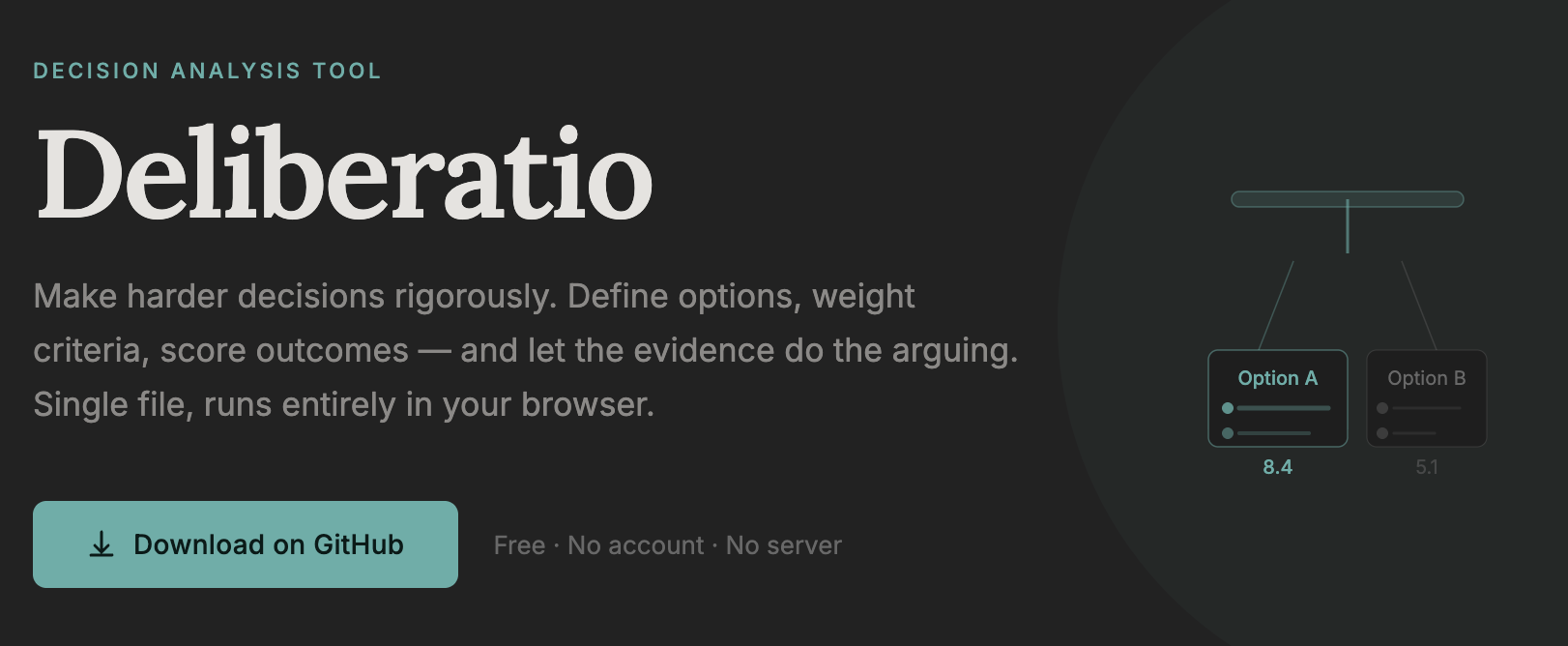
It is completely free, runs entirely in your browser, and stores all data locally on your own computer.
I'd be delighted to hear your thoughts, suggestions and criticisms - please do get in touch.