
Meridian
Evidence-based giving, measured.
Ask most donors how much they have given this year and they can usually tell you within a few minutes. Ask what those donations were expected to accomplish and the answers become much vaguer. We are good at tracking money leaving our accounts. We are not good at tracking what that money achieves.
This asymmetry is not accidental. Measuring outflows is easy: your bank statement does it for you. Measuring impact requires you to engage a question that most of us find easier to leave open. If you give £100 to a local cause you feel warmly about, and £100 to Against Malaria Foundation where GiveWell estimates it averts roughly one DALY at that price, those two acts are recorded identically in your accounts. They are not identical. The difference between them is the thing most donors never measure.
Giving without measurement produces a false sense of completion. The box is ticked. The direct debit runs. The confirmation email arrives. The moral work feels done. What was actually accomplished remains vague, which is comfortable, but it is also epistemically dishonest for anyone who has spent ten minutes thinking seriously about what their giving is for.
Peter Singer's argument, made in 1972 and still unrefuted in its essentials, is that geographical distance does not reduce our obligation to prevent serious suffering. Meridian starts from the practical corollary: if your £100 can avert two DALYs at one charity and 0.4 DALYs at another, treating those donations as equivalent is not just imprecise. It is a choice to remain uninformed about the consequences of your own decisions.
GiveWell has spent fifteen years building the infrastructure to make this comparison tractable. Their annual cost-effectiveness models reduce charitable impact to a common unit: the Disability-Adjusted Life Year (DALY), representing one year of full health averted by intervention. Their 2024 model estimates AMF at approximately £100/DALY; GiveDirectly at approximately £250/DALY. These are contested estimates with wide uncertainty ranges. They are also far better than nothing, and they make visible a comparison most donors never see.
I wanted a tool that held this comparison in front of me continuously, integrated with everything else I track: monthly giving, cause allocation, pledge compliance, and net cost after UK tax relief. Nothing like it existed. So I built one.
Meridian is a single-file HTML dashboard that runs entirely in your browser. It computes expected DALY impact for each charity in your portfolio using an effectiveness score anchored to a configurable baseline (default: £100/DALY, matching GiveWell's benchmark), and combines this with full donation history, Gift Aid, higher rate relief, pledge tracking, and cause allocation in one view. It exports to JSON, HTML, Excel, and CSV. Nothing leaves your machine. And it also works for donors who live in the US, Germany, and other countries.
How to use it
The workflow is sequential and the order matters.
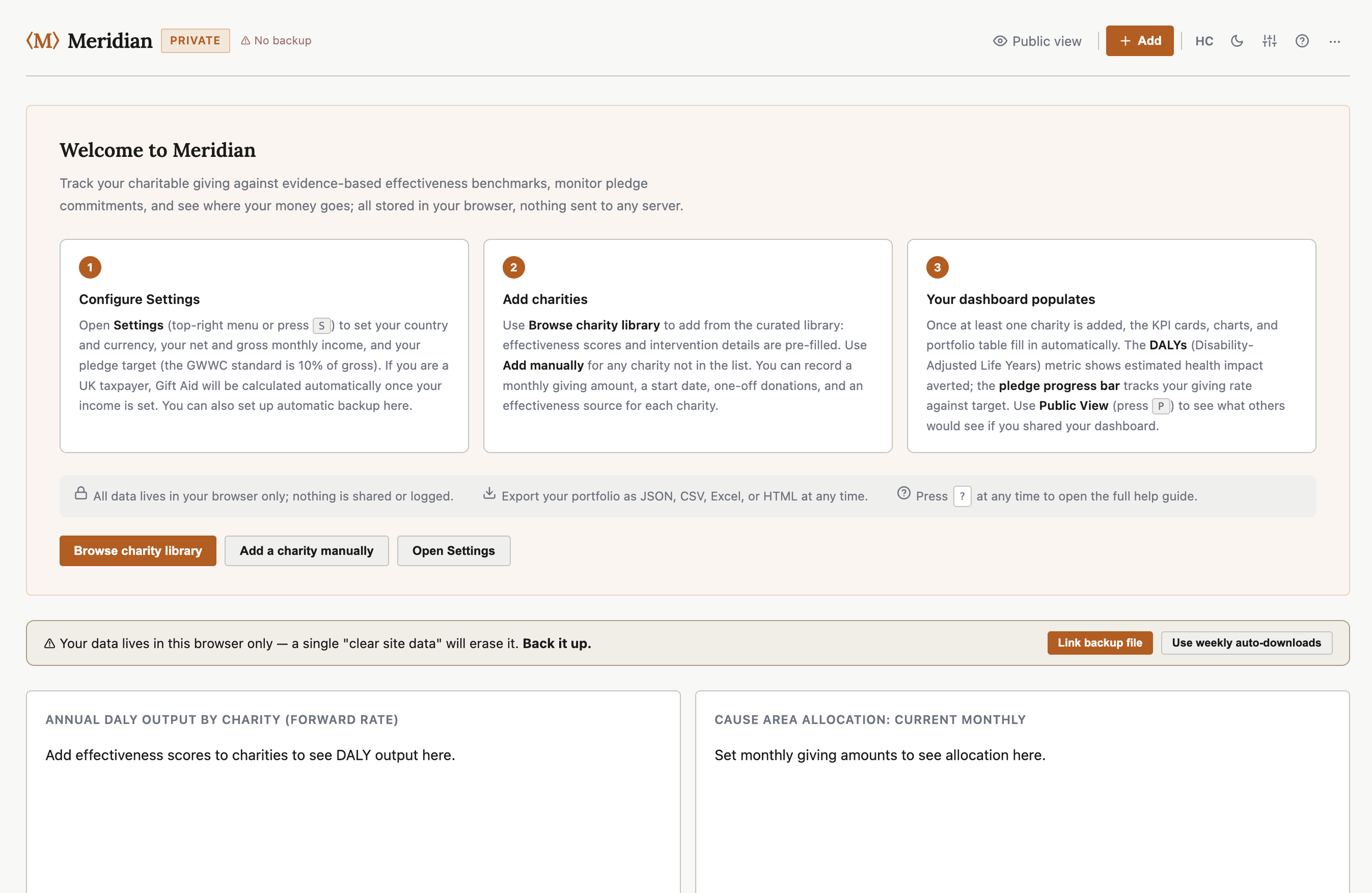
Start with configuration, not data entry. Open Settings first. Set your DALY baseline (leave at £100 to use GiveWell's benchmark as the anchor), your country (affects currency and Gift Aid), and your income if you want pledge tracking. These parameters affect every calculation in the tool; setting them before adding charities avoids retroactive surprises.
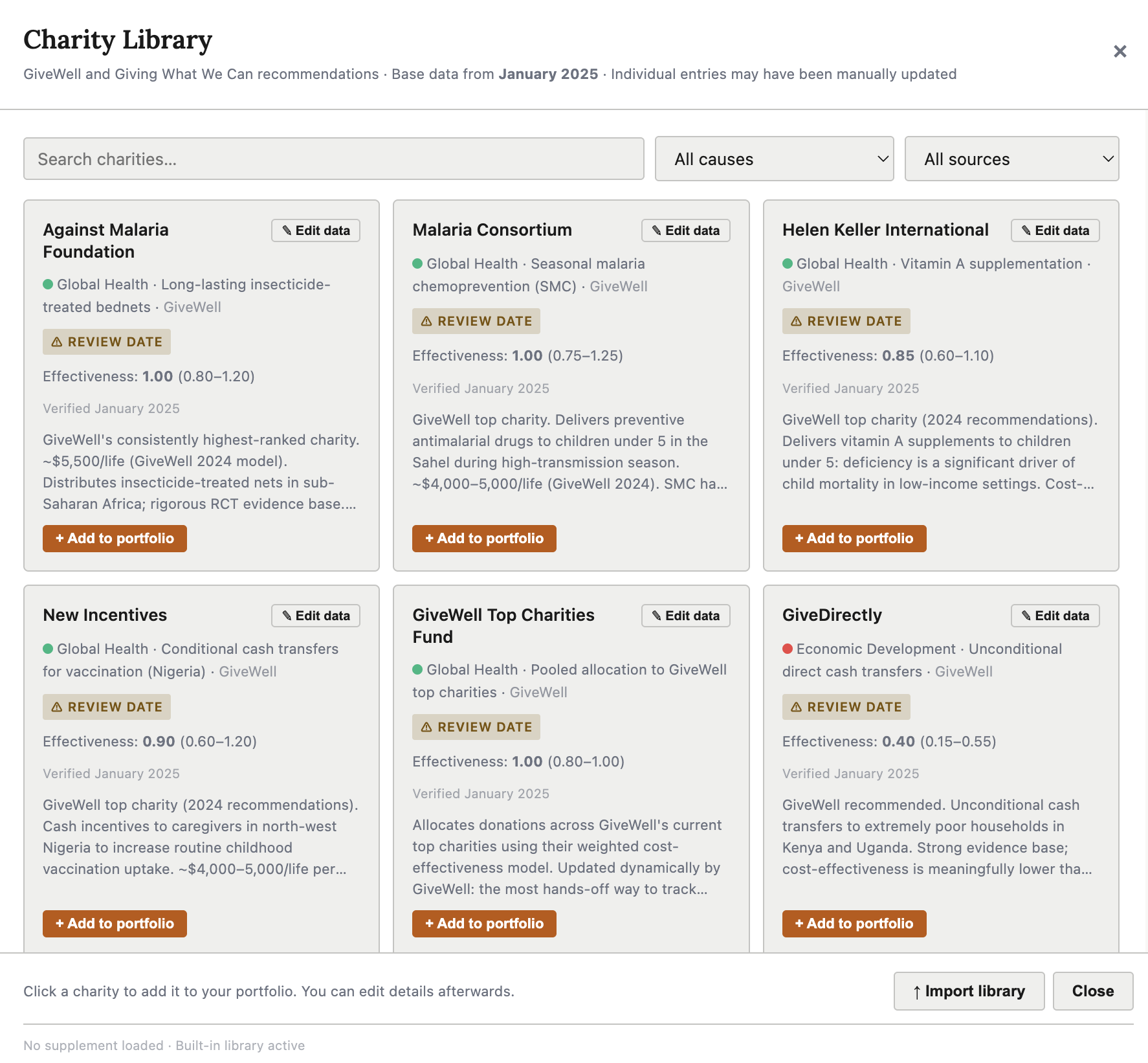
Add charities from the library before adding manually. Meridian ships with 34 pre-loaded charities and funds from GiveWell, GWWC, Animal Charity Evaluators, and Founders Pledge. Each carries an effectiveness score, an uncertainty range, and source links. Adding from the library takes two clicks and pre-populates the effectiveness data; you supply the donation amounts. For charities not in the library, Add → Manual covers the rest.
Enter full rate history, not just the current figure. The tool models donation history as a series of rate periods. If you have been giving to a charity for three years at different amounts, enter each period separately. The cumulative DALY total depends on it. Entering only the current rate understates your historical impact and overstates the recency of your giving. Retrospective accuracy is one of the more motivating things the tool produces: seeing the total you have accumulated over the years is different from seeing what you are giving this month.
Verify effectiveness scores before trusting the output. The built-in library reflects the most recent data available at the time it was last updated. Stale scores, not reviewed in 12 months or more, are flagged with a warning badge. That badge is an action item. An outdated score that looks authoritative is strictly worse than no score.
Set up backup before you rely on the tool. Everything is stored in your browser's localStorage. Clearing site data or moving the file erases your portfolio. In Settings → Backup & Sync, link a local file and place it in a cloud-synced folder: Dropbox, iCloud Drive, OneDrive. The tool writes to it silently on every change. Configure this first, before entering data that would be painful to lose.
Review the What-if simulator and cause allocation quarterly. These two views together answer the question the rest of the tool builds towards: is my portfolio actually pointed where I think it is, and what would it mean in concrete DALY terms to give a little more?
What the tool is not
Meridian does not make your giving more effective. It makes the gap between where you are and where the evidence points visible. That gap may be uncomfortable. The tool has no mechanism to protect you from it.
The DALY calculations are only as accurate as the underlying estimates. GiveWell's low and high estimates for AMF differ by a factor of roughly 1.5. The tool surfaces ranges rather than collapsing them, but displaying a range does not manufacture precision that is not in the data. You can set your own parameters in settings.
Cross-cause comparisons are harder still. Charities in animal welfare and longtermism are marked n/q rather than assigned speculative conversion factors. The philosophical basis for comparing them to global health interventions is genuinely contested: the literature does not converge on a stable number, and the tool will not invent one.
The pledge tracking section shows the gap between your current giving and your target. It cannot close it for you.
Meridian is free for personal use. Download the file, open it in Chrome, and set up the backup before you enter anything you care about keeping.
I would love to hear your feedback and ideas about how to make it better, so please get in touch!