
Sententia
A Version Control for Your Beliefs
We track almost everything that matters.
Our finances, our health, our sleep, our habits, our exercise, our investments, and increasingly even our moods. Modern life is full of dashboards, graphs and historical records. We can see how our weight changed over the last decade, how much we spent on groceries last month, or how many steps we walked yesterday.
Yet there is one thing that arguably shapes our lives more than any of these, and almost none of us track it at all: our beliefs.
If I asked you how your views on artificial intelligence, free will, democracy, consciousness, or effective altruism have changed over the last five years, you could probably tell me a story. But could you say how confident you were at each stage? What evidence changed your mind? Which assumptions did those beliefs depend on? Or what you thought before reading a particular book or having a particular conversation?
Most of us can't. We remember the destination but not the journey.
That strikes me as a curious omission. Beliefs are the foundation of our decisions, yet we rarely treat them as something that deserves careful observation. Once an opinion settles into place, it tends to become part of our identity rather than an estimate that should continue to compete with new evidence.
Why beliefs are difficult to revise
Changing your mind sounds straightforward. Learn something new, weigh the evidence, and update your beliefs accordingly.
In practice, it is rarely that simple.
Decades of research in psychology have shown that human judgement is shaped by predictable cognitive biases. One of the most influential is anchoring. Once we have committed to a number or an estimate, subsequent estimates tend to remain surprisingly close to it, even when that starting point is arbitrary or no longer justified.
This matters because many of our beliefs are uncertain by nature. We are rarely 100% certain that a political system will outperform another, that a philosophical argument succeeds, or that a particular technological prediction will come true. These are questions of probability rather than certainty. Yet once we privately settle on "about 80%" or "probably true", that estimate quietly becomes the reference point around which future updates revolve.
The result is that many apparent belief updates are little more than small adjustments around an old position.
There is another problem.
Philip Tetlock's research on forecasting found that the people who consistently made the most accurate predictions weren't distinguished primarily by intelligence or expertise. What separated them was how they approached uncertainty. They expressed confidence numerically rather than categorically, updated their estimates incrementally as evidence changed, and remained unusually willing to revise their views.
Those habits are learnable, but what is largely missing are tools that make them easy to practise.
The problem with ordinary note-taking
Most note-taking applications are excellent at recording information, but they are much less useful for recording uncertainty.
You can write that you believe something, but not how strongly. You can edit a note, but unless you deliberately preserve every revision, you lose the history of how your thinking evolved. You can keep a journal, but journals are chronological rather than structured. They are designed to capture moments in time, not to answer questions such as:
Which of my beliefs have changed the most over the past three years?
Which assumptions support large parts of my worldview?
Which beliefs have remained remarkably stable despite repeated review?
What evidence has actually caused me to change my mind?
I realised I wanted something closer to version control for beliefs than another notebook.
Building Sententia
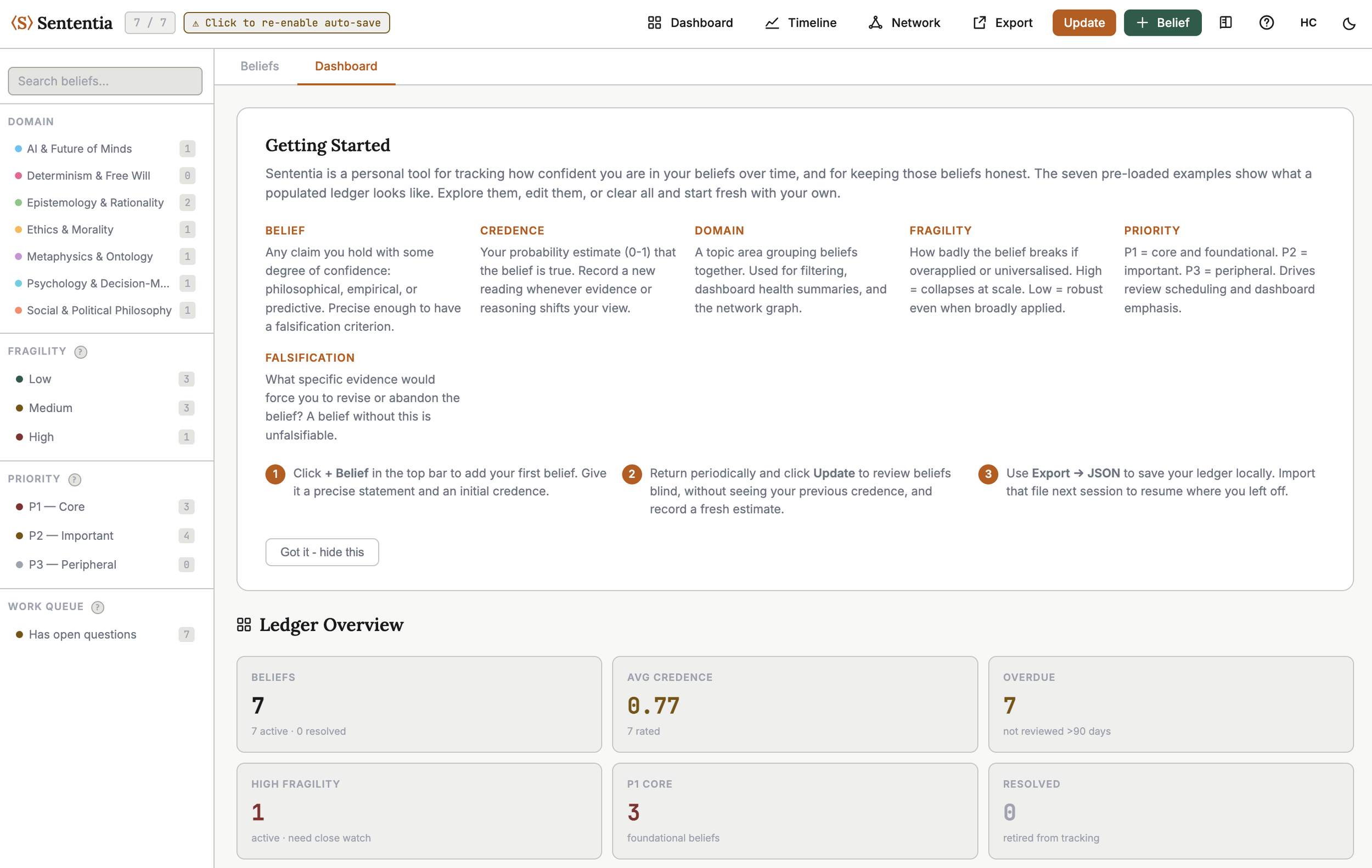
That was the motivation behind Sententia. Sententia is a small, local-first application that treats beliefs as hypotheses rather than convictions.
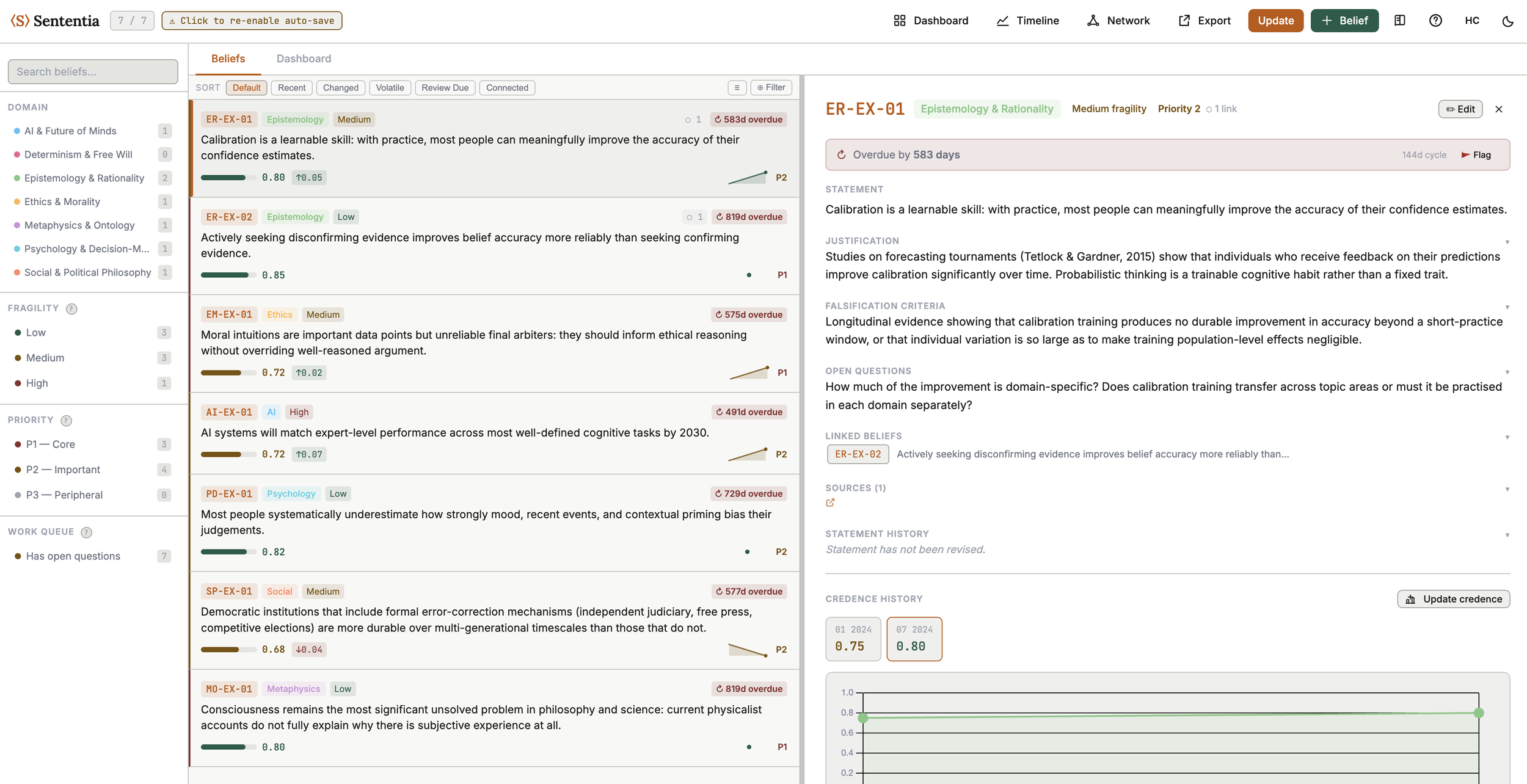
Each belief consists of more than just a statement. It includes a numerical credence, supporting reasoning, explicit falsification criteria, links to related beliefs, and a complete history of every revision you've made. Rather than overwriting your previous thinking, each review becomes another entry in a growing record of how your worldview has evolved.
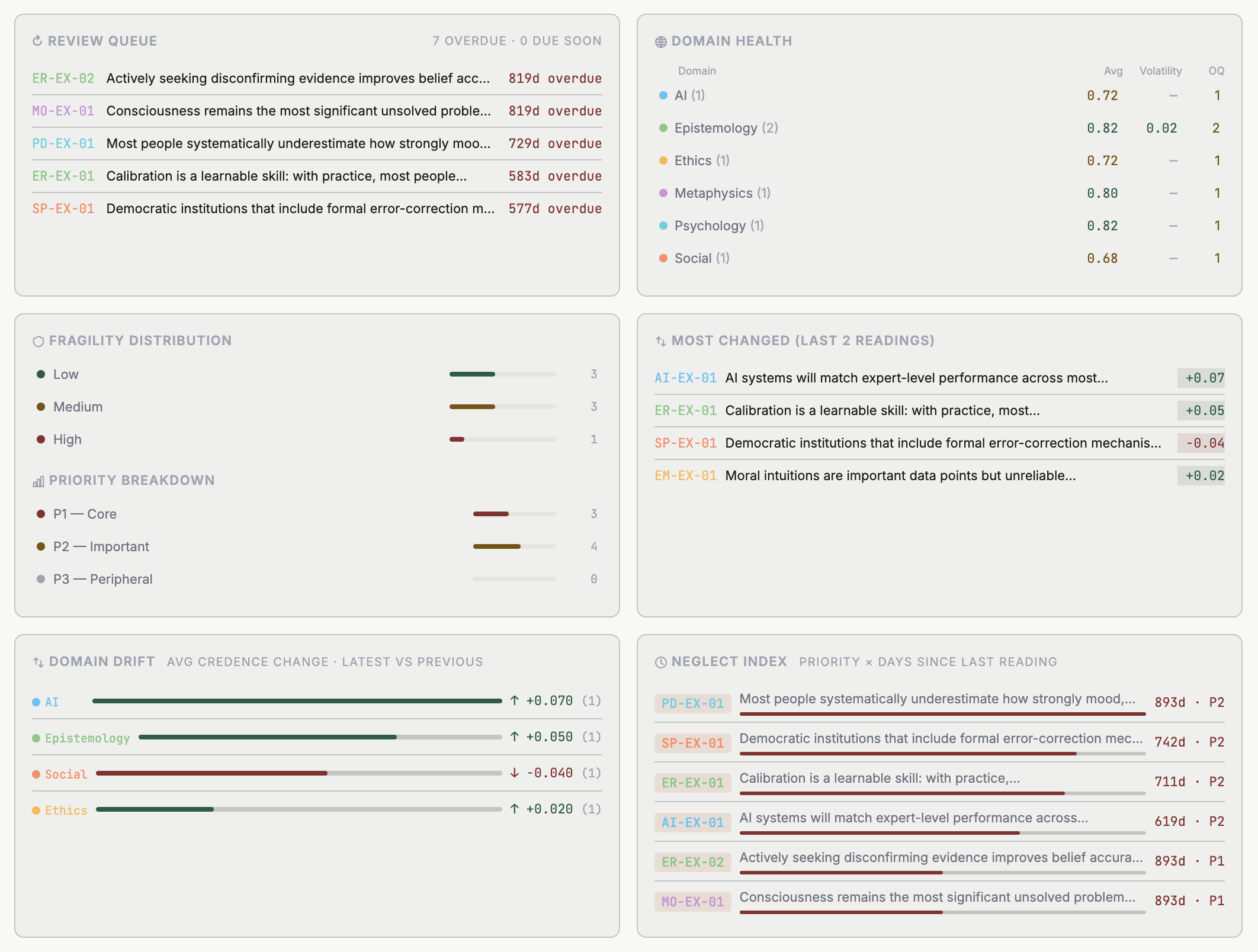
Over time, patterns begin to emerge. Some beliefs remain remarkably stable while others fluctuate as new evidence arrives. Some assumptions quietly influence dozens of other beliefs without you ever noticing. Seeing those relationships develop over months and years is, at least for me, far more valuable than simply recording isolated opinions.
The feature I'm happiest with is something I call Blind Review.
When it's time to review a belief, Sententia deliberately hides your previous credence. You first decide what you think today. Only after you've committed to a new estimate does the application reveal your previous value and show how your confidence has changed. Instead of adjusting an old estimate, you're forced to make a fresh judgement. Only afterwards do you compare today's thinking with yesterday's. That separation between estimation and comparison is the heart of the application.
A tool, not a philosophy
It's worth saying what Sententia is not:
It doesn't tell you what to believe.
It doesn't claim to make you more rational.
It doesn't prevent motivated reasoning or guarantee good judgement. A dishonest estimate entered into Sententia is still a dishonest estimate.
The application simply provides a structure for expressing uncertainty explicitly, revisiting important beliefs deliberately, and observing how your thinking changes over time. Whether that leads to better reasoning depends entirely on the person using it. Nor is it intended to replace ordinary notes or journals. Those tools answer different questions. They capture ideas, experiences and information. Sententia is concerned with something narrower: the evolution of belief under uncertainty.
Why I decided to publish it
I originally built Sententia for myself. I wanted a better way of understanding how my own thinking changed over time, particularly on questions where certainty is neither possible nor desirable. After using it for a while, it occurred to me that the underlying problem probably wasn't unique to me. Many thoughtful people try to remain intellectually honest. They try to change their minds when evidence changes. They try to distinguish confidence from certainty.
But very few seem to have any practical way of doing so consistently. Publishing the tool seemed worthwhile simply because someone else might find it useful. If nobody does, that's perfectly fine. It has already served its original purpose. If others do, even better.
Try it yourself!
Sententia is completely free and runs entirely on your own computer. There is no installation, no account, no subscription, and no cloud service. Your data remains local, and the entire application is contained in a single HTML file. If the idea of treating beliefs as living hypotheses rather than fixed convictions resonates with you, you can download Sententia from GitHub, where you'll find the application, screenshots, and documentation:
I'd be genuinely interested to hear how other people use it, what they find useful, and where they think the idea could be improved - let me know!