

Which causes deserve priority?
The framework I find most useful for thinking about cause prioritisation is ITN: Importance, Tractability, and Neglectedness. Importance asks how much suffering or flourishing is at stake. Tractability asks whether additional resources can realistically make progress. Neglectedness asks whether the problem is already receiving substantial attention and funding. What I find valuable about the framework is that it forces me to separate questions that are often blurred together. A cause can be hugely important and still be a poor target for marginal donations if progress is extremely difficult or if enormous resources are already flowing into it.
Applying this framework has gradually shaped how I think about giving. Global health still receives the largest share of my donations because the evidence base is unusually strong and the impact is measurable in a way that inspires relatively high confidence. At the same time, I remain persuaded by the importance and neglectedness arguments for areas like AI safety and animal welfare, even where the uncertainty is much greater. None of these allocations feel final or perfectly resolved to me. Cause prioritisation ultimately requires making provisional judgements under real moral and empirical uncertainty, and being willing to update them as new evidence emerges.
This is Part 3 of 5 of the Giving With Intention series. Read Part 1 and Part 2
My previous post ended with an honest admission. The evaluation framework described there (cost-effectiveness per DALY, evidence quality, counterfactual impact, room for more funding) answers how to compare charities within a cause area, but it does not answer which cause areas to look at in the first place.
That gap matters more than it might appear. A donor who applies rigorous within-cause evaluation but selects the wrong cause area is optimising the "wrong" thing (at least in some sense). Comparing the best global health charity to the best animal welfare charity to the best AI safety organisation cannot be done using the same framework I described in Post 2. The metrics cannot be compared to each other without too much noise being inserted. It requires a different kind of reasoning and a different tool.
The ITN framework
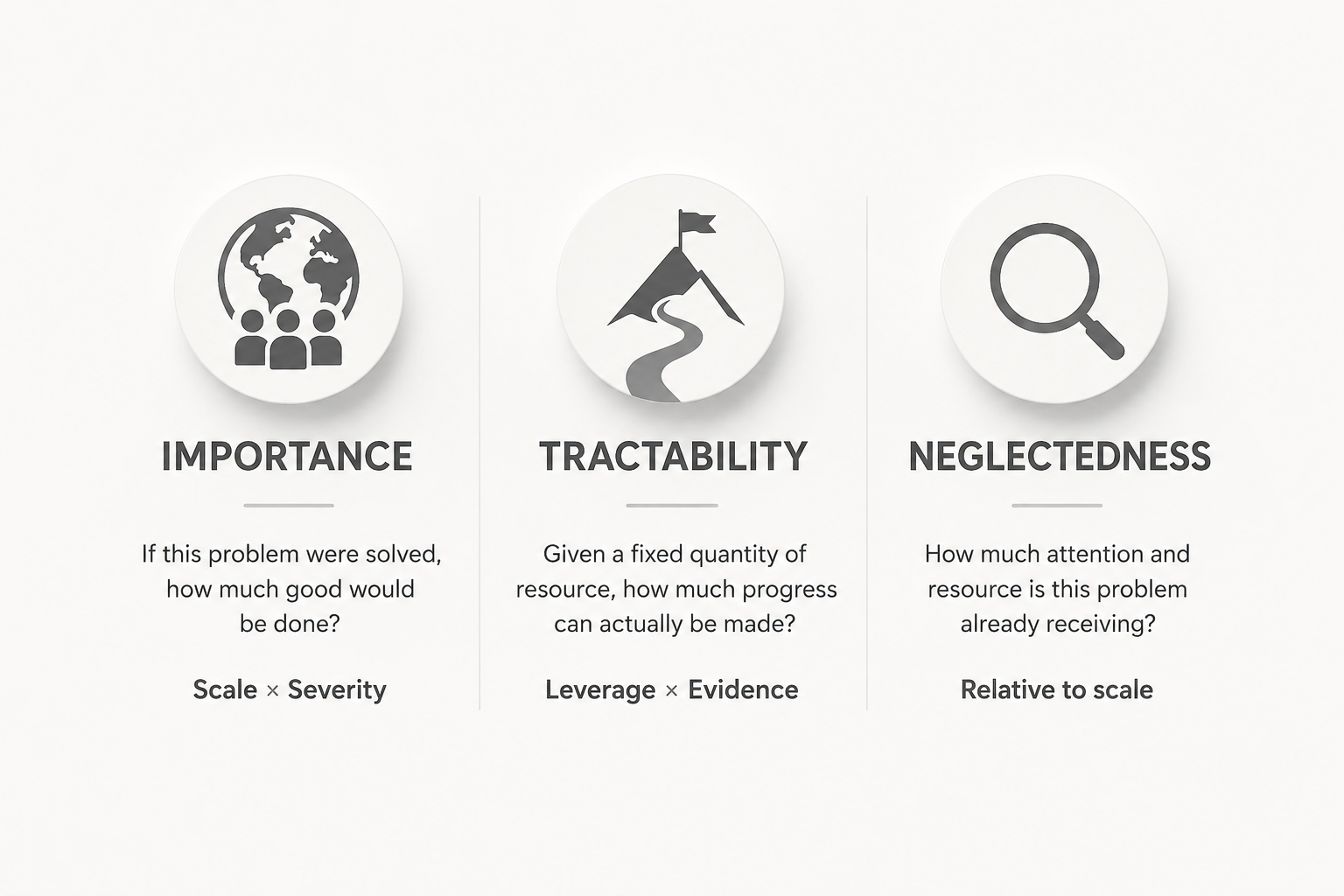
The framework most commonly used in effective altruism for cause prioritisation is ITN which stands for Importance, Tractability, and Neglectedness. It was developed partly at the Centre for Effective Altruism and elaborated by researchers at 80,000 Hours. The three dimensions are deliberately distinct, and the failure to keep them separate is the source of most confused thinking about cause selection. Let's have a look at what ITN means in practice.
Importance asks: if this problem were solved, how much good would be done? This is a function of scale (how many beings - typically human and non-human - are affected?) and severity (how badly?). Importance is the dimension that rewards thinking large. A problem affecting a billion people is, all else equal, more important than one affecting a million. That sounds obvious. Yet, as we will see in future posts, psychological phenomena like scope neglect make even this less intuitive than one might expect.
Tractability asks: given a fixed quantity of resource, how much progress can actually be made? A problem can be enormous in importance and almost entirely intractable to intervention, not because it is unsolvable in principle, but because no reliable, evidence-backed lever exists for an individual donor to pull, or because the funding required to solve it is simply enormous. Tractability is where the within-cause evaluation methodology from Post 2 does most of its work.
Neglectedness asks: how much attention and resource is this problem already receiving, relative to its scale? This third component of the ITN framework is usually the least obvious and is rarely considered by mainstream organisations. A cause that attracts ten times more funding than another of equal importance and tractability is, all else equal, a worse use of marginal donations. This is the counterfactual argument applied at the cause level rather than the charity level. Where everyone is already looking, an additional pair of eyes adds less, and the impact one can make is severely limited.
The ITN framework does not produce a single numerical score that resolves cross-cause comparisons. It is a structured way of asking the right questions. Those questions, applied honestly, require comparing values: how much does the suffering of a factory-farmed animal weigh against the suffering of a child with malaria? Those comparisons involve irreducible moral uncertainty (which we will address in one of the upcoming posts). Now, let me explain how I navigate that uncertainty.
Global health
By ITN standards, global health performs well on all three dimensions, and it does so in the cause area where the evidence base is most robust.
The importance case is not in dispute. Disease, malnutrition, and preventable death impose an enormous burden concentrated in the world's poorest populations. The scale is measured in hundreds of millions of affected lives; the severity, across the cluster of interventions that effective giving targets, is high. Around five million children under five die each year globally, the majority from causes that are preventable at low cost. Diarrheal diseases alone kill around 340,000 children annually; pneumonia kills more. Malnutrition compounds both, depressing cognitive development and productivity across entire generations in low-income countries. Malaria alone kills around 600,000 people per year, the majority of them children under five.
Tractability in global health is unusually strong. The interventions that GiveWell and its peers recommend are not hypotheses; they are supported by multiple randomised controlled trials across different geographies and time periods. The cost per DALY averted is measurable, and the measurement is reliable enough to support meaningful cross-charity comparisons.
Neglectedness is the more nuanced dimension. Global health receives substantial philanthropic and government funding, which reduces its neglectedness score relative to some cause areas. But the absolute funding gap between what is needed and what is actually spent remains large, and the marginal value of additional well-directed giving is demonstrably high. GiveWell's continued identification of funding gaps at its top charities serves as a practical test: the saturation point has not been reached.
Global health is where the majority of my giving goes. That weighting reflects not only the ITN framework but a strong moral prior: interventions with a robust evidence base and predictable, near-term outcomes deserve priority over those where the causal chain from donation to impact is longer and harder to verify. I try, first and foremost, to think with my brain and apply reason through any charitable giving. At an emotional level, it is extremely hard not to be moved by the level of global suffering, especially in low- and middle-income countries, and by the fact that many such deaths are still due to preventable diseases. The scale of suffering in the world is indeed immense, despite the massive progress the world has made over the last 50 years.
Longtermism and AI safety
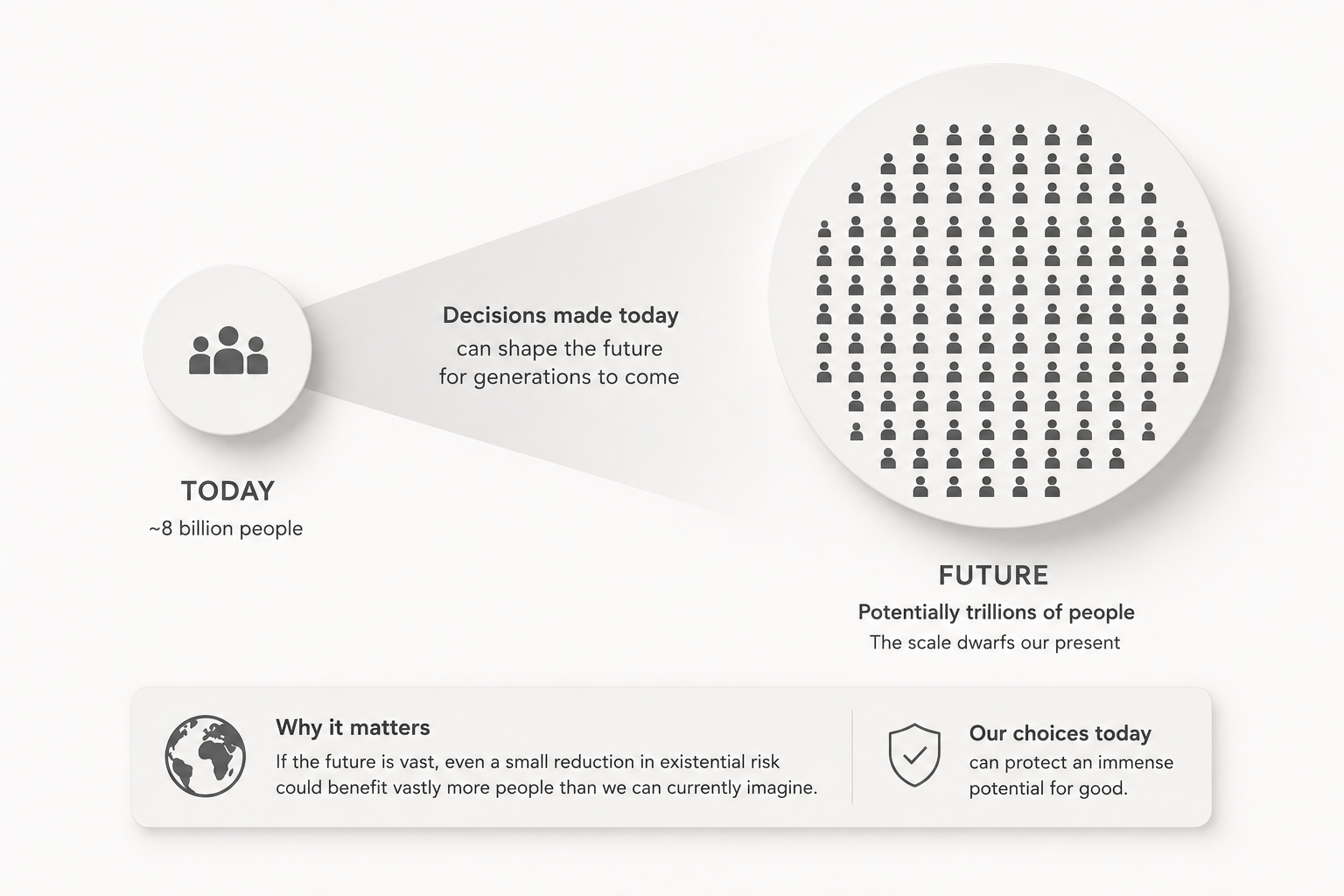
The case for longtermism begins with a straightforward observation. If future generations exist in numbers comparable to current projections, the number of people whose welfare might be affected by decisions made today is orders of magnitude larger than the current global population. Under a utilitarian calculus, even a modest reduction in the probability of a catastrophic outcome (one that forecloses the possibility of those future generations) could justify substantial resource allocation. This line of reasoning can lead to extreme conclusions and spiral quickly into counterfactuals against infinities; the expected-value arithmetic is not easy to dismiss, however.
On the ITN dimensions: importance is potentially very high, on the assumption that the future is astronomically large and that it can be influenced. Neglectedness is also high; the number of researchers working seriously on AI safety, biosecurity, and global catastrophic risk remains small relative to both the potential scale of the problem and the resources available globally. These fields have not attracted institutional attention proportional to what their potential importance might warrant.
Tractability is the dimension where most honest disagreement falls. The causal mechanisms between a donation to an AI safety research organisation and a reduced probability of a catastrophic AI outcome are long, indirect, and genuinely difficult to evaluate. There are no randomised controlled trials. The evidence base is, by the nature of the problem, thin and contested. In addition, given that many of these interventions are about preventing a global catastrophic risk, it is extremely hard to know whether a particular intervention was necessary to prevent a specific civilisation-level risk from happening or whether the same risk would not have materialised for other reasons anyway.
I hold a meaningful allocation to this cause area because I find the importance and neglectedness arguments compelling enough to justify acting under tractability uncertainty. But I hold that allocation with lower confidence than my global health giving, and I would update quickly on evidence that tractability is lower than it currently appears. Moral uncertainty about very long time horizons and large populations is real, and epistemic humility about expected-value reasoning over those scales is warranted. I will admit that my thinking on this continues to evolve, and I might come to different conclusions in the future.
Climate change
The ITN framework applied straightforwardly to climate change produces a result that may surprise anyone who expected effective giving to align with mainstream philanthropic priorities.
Importance is clearly very high. The science on anthropogenic climate change is not in question, and the scale of potential harm across human and non-human populations is large.
Tractability is debated but not negligible. Solutions exist in principle; the constraint is deployment speed, political will, and economic transition, not fundamental scientific uncertainty.
The problem is neglectedness. Climate receives more philanthropic attention, government funding, and public discourse than almost any other cause area. Billions flow from foundations, governments, and corporate sustainability programmes. By the logic of the neglectedness dimension, the marginal impact of an additional donor is likely to be low relative to what is possible in cause areas receiving a fraction of that attention.
I am not a climate sceptic in any sense. My uncertainty is not about whether the problem is real or serious. It is about where a marginal donation makes the most difference. My approach is therefore to maintain a smaller allocation to a climate-focused charity (specifically the Clean Air Task Force, which Founders Pledge has rated as among the most cost-effective climate organisations by tonnes of CO₂e avoided) despite the ITN calculus not fully supporting it. This is, in some sense, a deliberate departure from the framework, and I label it honestly. Some causes carry weight that is not fully captured by expected-value reasoning under neglectedness. I am unwilling to reduce my giving to zero in a cause area of this importance purely because it attracts more attention than most. That is a values-driven exception rather than a conclusion the framework produces on its own. In the same vein, despite lower effectiveness by ITN standards, I also continue to give to Cancer Research.
Animal welfare
The scale of suffering in industrial animal agriculture is difficult to take in fully. Over 80 billion land animals are raised and slaughtered under factory farming conditions each year, a figure so large it resists intuition. By any account of sentience that extends moral consideration beyond humans, the welfare costs are enormous. The evidence that vertebrates, and likely many invertebrates, experience pain and distress in meaningful ways is substantial; a 2021 UK government-commissioned review of over 300 studies concluded that decapod crustaceans alone warranted legal protection as sentient beings. For those unfamiliar with the conditions at scale, Dominion, filmed with drones and hidden cameras inside commercial farms and slaughterhouses across Australia, is a difficult but useful corrective.
On the ITN framework: importance is very high on scale alone. Neglectedness is also high; the cause receives relatively little serious philanthropic attention relative to the number of beings affected and the severity of their conditions. Tractability is real and improving: corporate accountability campaigns have achieved meaningful cage-free commitments from major food companies; alternative protein research is advancing; dietary shift programmes have evidence behind them. The causal chains are less direct than in global health, but they are not speculative.
My allocation focuses on factory farming interventions rather than wild animal suffering, guided by Animal Charity Evaluators recommendations. The philosophical case for caring about wild animal suffering is coherent, but the practical tractability of targeting it directly remains very low. Wild animal suffering is morally important; it does not currently meet the tractability threshold. Organisations working to reduce consumption, improve conditions within existing food systems, and accelerate the transition to alternative proteins are where I find the most credible near-term impact.
Animal welfare sits third in my giving in terms of priority. I suspect it is underweighted globally, and possibly in my own portfolio. The moral case is strong, the neglectedness is genuine, and the cause has historically been treated as peripheral to serious philanthropic discussion. That treatment is not well-justified by the evidence.
Navigating across causes
Committing to a cause-area weighting requires making provisional judgements under genuine uncertainty and being willing to revise them. It does mean engaging seriously with the data available and comparing them against one's axiology and willingness to interrogate one's own moral priorities. In this context, I have always found Peter Singer's work clarifying, particularly on practical ethics and the moral consideration of animals.
Global health gets the majority of my giving because the evidence is strongest, the tractability is highest, and the moral case is immediate and legible. Longtermism and AI safety get a meaningful but smaller share because the importance and neglectedness arguments are compelling even where tractability is uncertain. Animal welfare receives a third allocation because the scale and neglectedness are undeniable, and the tractability is improving. Climate receives a smaller allocation that does not fully follow from the ITN framework but reflects a considered departure from it.
What those allocations actually are, in percentage terms and at the level of specific charities, is what the next post covers.
Giving with intention is a five-part series documenting how I think about charitable giving: the framework I use, how I evaluate charities, how I have structured my portfolio across cause areas, and what I have got wrong.

Most charity evaluation measures the wrong thing
Singer's argument answers the whether question. It does not answer the how. Once I accepted that giving substantially was both morally sensible and practically required, I found myself facing a different and considerably harder problem: how do you know whether a charity is actually worth giving to?
My first instinct was to look for external validation. Charity watchdogs exist precisely for this purpose: Charity Commission filings in the UK, Charity Navigator in the US, assorted rating schemes that purport to separate responsible organisations from careless ones. What I found was a methodology built almost entirely on the wrong question.
This is Part 2 of 5 of the Giving With Intention series. Read Part 1 and Part 3
Singer’s argument, which I wrote about in the first post in this series, answers the whether question. It does not answer the how. Once I accepted that giving substantially was both morally sensible and practically required, I found myself facing a different and considerably harder problem: how do you know whether a charity is actually worth giving to? If I really wanted to ensure I am making as much impact with my donations as possible, how do I determine which causes, charities or institutions to focus on?
My first instinct was to look for external validation. Charity watchdogs exist precisely for this purpose: Charity Commission filings in the UK, Charity Navigator in the US, assorted rating schemes that purport to separate responsible organisations from careless ones. What I found was a methodology built almost entirely on the wrong question.
The overhead ratio is not a measure of impact
The dominant heuristic in mainstream charity evaluation is the overhead ratio: what percentage of income does an organisation pass through to programmes versus spending on administration, fundraising, and staff? Charities that exceed roughly 20 to 25% overhead are treated with suspicion. Those below it are treated as virtuous.
While this superficially looks like a sensible indicator to optimise for, it is a measure of organisational tidiness. It is not a measure of impact, and treating them as interchangeable produces real distortions.
A charity that spends 5% on overheads and delivers a programme with no evidence of effectiveness is worse than one that spends 30% on overheads to run a rigorously evaluated intervention that demonstrably works. The overhead figure tells you nothing about what the money achieves. It tells you something about how the accounts are structured.
There is a deeper problem. Overhead ratios actively penalise the activities that produce good outcomes: monitoring, evaluation, randomised controlled trials, and staff capable of designing interventions and interpreting evidence. A charity that invests in understanding whether it works is, under the overhead metric, a worse charity than one that spends all its money on inputs without ever asking about outputs. The incentive runs exactly backwards and effectively penalises investments into outcome optimisation.
It became very clear to me that treating overhead as the primary signal is clearly not helpful and I realised that quite early in the process. Finding a better approach took a bit longer.
What cost-effectiveness actually measures
The question I eventually settled on is simple to state: what does £1 buy, in terms of human welfare? Answering it requires having some mechanism to measure welfare, which is not a trivial challenge.
In practice, two units are commonly used, and they measure the same thing from opposite directions. A QALY (Quality-Adjusted Life Year) represents one year of full health gained; it is the standard unit in high-income healthcare systems, including the NHS. A DALY (Disability-Adjusted Life Year) represents one year of healthy life lost, either to premature death or to illness and disability; it is the standard unit in global health economics, used by the WHO and the research bodies that evaluate interventions in low-income settings. One averted DALY corresponds roughly to one QALY gained. The distinction matters in practice because the contexts in which each metric is used are quite different.
The UK’s National Institute for Health and Care Excellence (NICE) typically approves treatments costing up to £20,000 to £30,000 per QALY gained. This is roughly what UK society has decided a healthy year of life is worth in a domestic healthcare context. Naive idealists may find the idea that you can assign a monetary amount to a year of someone’s life somewhat repulsive but, in the real world, governments and organisations do this (and have to do it) all the time to make decisions about different policies.
Now contrast the number above with what follows. The Disease Control Priorities project, a large academic collaboration that evaluates interventions across low-income settings, estimates that many of the most effective global health programmes avert a DALY for well under $200. GiveWell, whose methodology I will come to, puts the cost per life saved at its top-rated charities in the range of $4,000 to $6,500, depending on geography and year. The implicit cost per DALY at that level is substantially lower than the NICE threshold, often by a factor of 50 or more.
This is not a rounding error. It is a structural consequence of two facts: disease burden is concentrated in low-income contexts, and intervention costs are structurally lower where wages and supply chains are different. The arithmetic does not change based on whether you find it comfortable. It’s clear that impact of one’s donation can be orders of magnitude larger if directed in the right way.
The scale of the asymmetry
Abstract multipliers are easy to discount so let’s look at concrete examples.
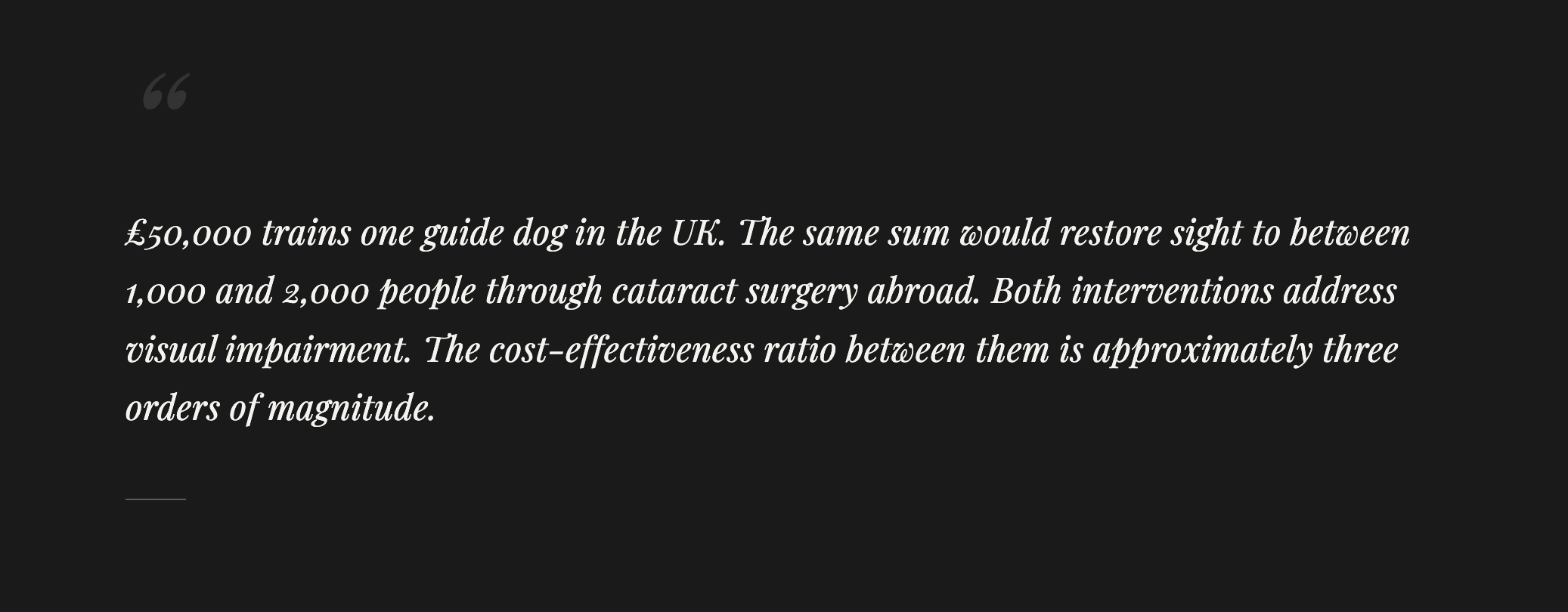
Guide Dogs for the Blind UK costs approximately £50,000 to train and place a single guide dog. That investment helps one person navigate the world with greater independence; the benefit is real and not trivial. By contrast, the cost of cataract surgery in a high-burden developing country context, through organisations such as Sightsavers, runs to roughly £25 to £50 per operation, restoring functional sight to a person who had lost it. At those prices, the same £50,000 would restore sight to somewhere between 1,000 and 2,000 people. Both interventions address visual impairment. The cost-effectiveness ratio between them is approximately three orders of magnitude.
The comparison is not a criticism of guide dog charities. It is an illustration of what geographic and economic context does to cost-effectiveness, independent of how well-run or well-intentioned an organisation is.
The same logic applies when comparing interventions across health contexts more broadly. Despite significant progress in recent decades, Malaria still kills around 600,000 people every year, many of them children. Long-lasting insecticide-treated bednets distributed in high-malaria-burden sub-Saharan Africa, at roughly $5 to $7 per net, prevent a substantial fraction of malaria deaths in the households where they are used. The cost per life saved, at scale, sits in the low thousands of dollars. Most charitable interventions operating in high-income countries cannot approach that ratio, not because they are doing less valuable work in absolute terms, but because the baseline cost structure of operating in those environments is entirely different.
This is the central asymmetry that evidence-based giving tries to navigate.
Counterfactual impact
Cost-effectiveness is necessary but not sufficient. A charity with a strong evidence base and favourable cost estimates still needs to pass a different question: Does my donation change what actually happens?
This is the counterfactual test. If a charity has more funds than it can productively deploy, or is delivering activities that would occur regardless of marginal donations, then additional money has no causal effect on outcomes. The organisation’s impact is genuine; my contribution to that impact is zero.
In practice, this means asking what GiveWell calls “room for more funding”: whether a charity can absorb additional donations, translate them into additional programme delivery, and do so within a reasonable timeframe. A charity with a funding gap and established operational capacity is a materially different bet from one that cannot deploy capital without degrading quality or accumulating reserves with no deployment plan.
I treat room for more funding as a filter, not a bonus. Evidence of effectiveness matters. So does evidence that my donation is adding to a distribution, not releasing pressure somewhere else.
GiveWell, Giving What We Can, and the case for independent evaluation
The most systematic attempt I know of to apply this framework at scale is GiveWell. Founded in 2007, it produces detailed cost-effectiveness analyses of a small number of charities that meet a high evidential bar. The methodology involves primary data, model-based projections, explicit uncertainty quantification, and published reasoning that can be audited and challenged. Their models are available in full; the assumptions are stated, not buried.
Giving What We Can (GWWC) takes a complementary approach. Originally a pledge community built around Toby Ord’s commitment to give 10% of lifetime income to effective charities, it has evolved into a broader recommendation platform that draws on multiple evaluators. Its Global Health and Wellbeing Fundcurrently allocates to GiveWell’s research, reflecting the degree to which GiveWell has become the reference standard in this domain. GWWC also maintains its own recommended charity list and extends into cause areas beyond global health, including animal welfare and global catastrophic risk.
Neither GiveWell nor GWWC is the only organisation doing this work. Founders Pledge produces comparable analysis for founders and high earners considering large donations. The Copenhagen Consensus has run systematic cost-effectiveness comparisons across a broader set of global priorities. For an individual donor making evidence-based decisions in global health, GiveWell remains the most thorough publicly available resource, but the ecosystem around it matters.
GiveWell’s current top charities, as of its most recent update, are the Against Malaria Foundation (bednet distribution in high-burden malaria regions), Malaria Consortium (seasonal malaria chemoprevention), Helen Keller International(vitamin A supplementation), and New Incentives (conditional cash transfers to increase childhood vaccination uptake in Nigeria). All operate in high-mortality, low-income contexts where the disease burden is concentrated and the cost per intervention is low.
A methodology that corrects itself
One feature of this approach that I find more compelling than any single cost-effectiveness estimate is the commitment to self-correction.
For instance, GiveWell maintains a public page titled “Our Mistakes,” updated regularly, that documents errors in research, modelling, and funding recommendations, along with what changed as a result. I find GiveWell’s epistemic honesty here genuinely compelling: this is not a public relations gesture, it is a live log of methodological revision and course correction. It’s impossible to never make a mistake, and having a robust mechanism that looks for errors and actively working to address them is a great way to maximise learning.
The most instructive example of an error made and subsequent course correction is No Lean Season. GiveWell recommended the programme, run by Evidence Action in Bangladesh, beginning in 2017. The intervention subsidised seasonal migration during the lean season, and two earlier randomised controlled trials had found significant effects on migration, income, and consumption. A third RCT, conducted in 2017 and reported to GiveWell in late 2018, found no statistically significant impact on migration. GiveWell removed the recommendation publicly in November 2018, published a detailed account of what the evidence showed and why it had updated, and Evidence Action shut the programme down in 2019.
This is the scientific method applied to philanthropy. The original recommendation was not made carelessly and naively. It was grounded in replicable evidence. And the removal of the charity was not defensive or delayed; it followed the evidence as soon as the evidence arrived. The whole process was documented publicly so donors could see the reasoning at every stage. That’s how it should be done.
Giving What We Can applies similar standards to its own recommendations, updating and revising as evaluator research changes. The output of both organisations at any given moment is not a definitive answer; it is the current best estimate, subject to revision.
I find this more credible, not less, than organisations that do not acknowledge errors. A methodology that cannot be falsified is not rigorous. One that actively invites falsification is.
What this framework does not answer
Running a charity through this framework, cost-effectiveness per DALY, evidence quality, counterfactual impact, room for more funding, changes the answer considerably from what instinct alone would produce. Most well-known UK (and indeed Western) charities perform poorly against it: not because they do bad work, but because they operate in high-income contexts where the cost of each intervention is structurally high. The charities that perform best are, almost without exception, absent from the fundraising solicitations in my inbox or in the mainstream public discourse.
This framework answers how to evaluate charities within a cause area. It is an approach that ought to be taken much more seriously by governments and public institutions alike, and it provides a rigorous (within what the available data allows) and systemic, self-correcting model for individuals to make informed decisions about their charitable giving. But it does not answer which cause areas deserve priority in the first place. Deciding how to weight global health against animal welfare against existential risk against climate change requires a different kind of reasoning, one that involves comparing not just cost-effectiveness but also scope, tractability, and how neglected a problem already is relative to its scale. That framework, and how I personally apply it, is the subject of the next post.
Giving with intention is a five-part series documenting how I think about charitable giving: the framework I use, how I evaluate charities, how I have structured my portfolio across cause areas, and what I have got wrong.

I gave to charity for eight years before asking if it worked
In 2007, the year our first child was born, I set up a direct debit to Cancer Research UK. It felt meaningful. I had no way of knowing whether it was. That question would take me the better part of a decade to begin answering properly.
Over the years that followed, the portfolio grew the way most people's giving grows: incrementally, emotionally, and without much strategy. A colleague mentioned a charity. A news story prompted a one-off donation. Each choice felt right at the time of making. None were made on the basis of any clear idea what the money was actually achieving. This is, I suspect, how most people give. The intention is genuine. The method is essentially nonexistent.
What changed things was a single short essay, written in 1972, that I heard mentioned on a podcast at roughly the right point in my life.
This is post 1 of 5 of the Giving With Intention series. Read Part 2 and Part 3.
In 2007, the year our first child was born, I set up a standing order to Cancer Research UK. Cancer had appeared in my family, which gave the choice a vague rationale, but beyond that I had no particular reason to choose it over anything else. Neither my family nor my wife's had any tradition of organised giving, no inherited framework for where charitable money should go or why. What we had was a new baby, and with it came a sudden and unfamiliar feeling of obligation. The charity felt serious. A safe, credible bet. The direct debit at the time was £25 a month. It felt meaningful, but I had no way of knowing whether it was.
That question, it turned out, would take me the better part of a decade to begin answering properly. The ten years since have been spent on little else.
On instinct
Becoming a parent changes the way you look at the world in ways that are difficult to predict in advance. I tend to think of myself as a fairly rational person, someone who works things through before acting, but becoming a parent altered my priorities in ways I had not anticipated. I started to notice things I had not paid attention to before. One of those changes was a sharp and immediate consciousness of scale and of responsibility. I had brought a child into a world with a great deal in it that was wrong, a great deal of suffering that was preventable, and a great deal of complacency from people, including myself, who had the means to do something about it but had not done much.
I did not think about this in those terms at the time. What I felt, more precisely, was that it would be dishonest not to act on it in some way. The Cancer Research direct debit was the path of least resistance.
Over the following years, the portfolio grew in the way that most people's charitable giving grows: incrementally, emotionally, and without much strategy. A colleague mentioned a charity. A news story prompted a one-off donation. A direct debit to a second organisation appeared, then a third. Each choice felt right at the time of making. None of them were made on the basis of any clear idea about what the charity was actually achieving with the money.
This is, I suspect, how most people give. The intention is genuine. The method is essentially nonexistent.
On not asking the right question
For a while, not asking felt acceptable. I was giving, which was more than most people around me were doing. The charities I supported were credible, respected, and well-known. Surely the money was going somewhere good. That was the assumption: I had no hard evidence for it, and I was not actively looking for any.
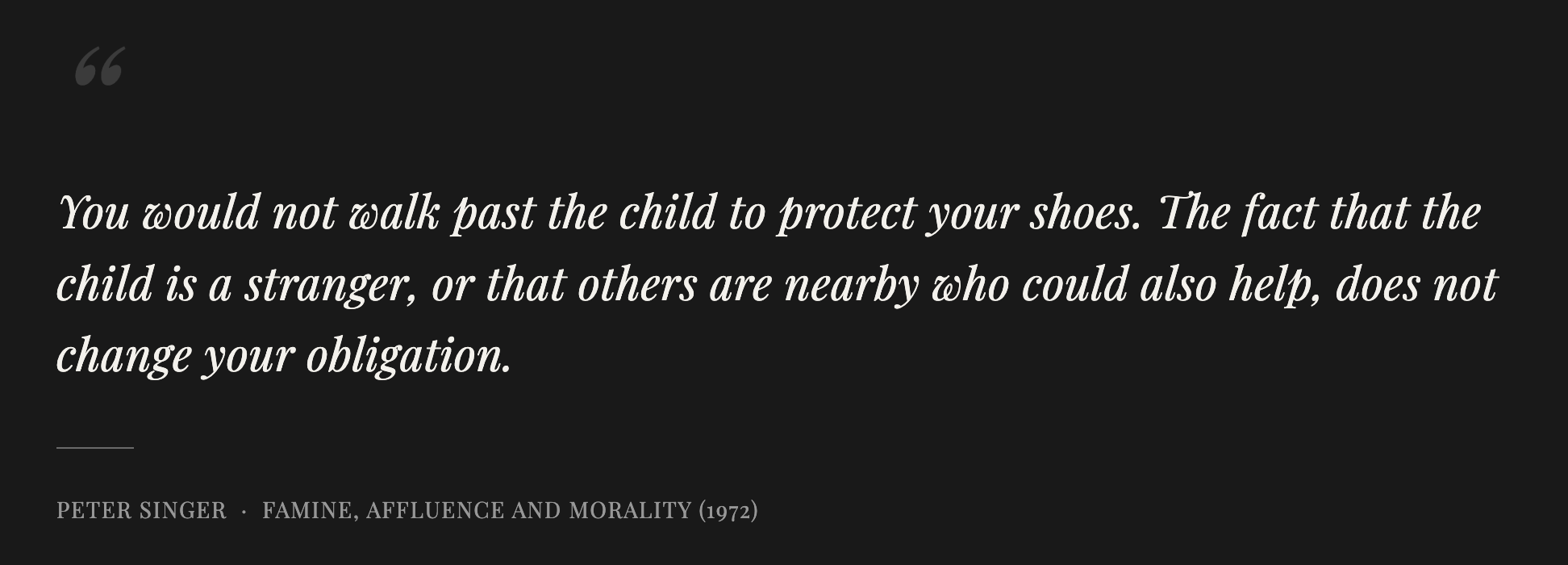
What broke the assumption was not a single dramatic moment. It was a short essay, written in 1972 by a philosopher named Peter Singer, that I heard mentioned on a podcast at roughly the right point in my life. The argument Singer makes is simple enough to state in a sentence: if you can prevent something very bad from happening at no comparable cost to yourself, you are obligated to do it. He illustrates this with the image of a child drowning in a shallow pond. You would not walk past the child to protect your shoes. The fact that the child is a stranger, or that others are nearby who could also help, does not change your obligation.
The argument is discomfiting in proportion to how seriously you take it. I took it seriously enough to sit with it for a while, and over time, it changed something in my thinking. It did not reassure me that what I was doing was sufficient. If anything, it pointed firmly in the opposite direction.
But Singer's argument answers the whether question. It does not answer the how.
The question that followed
Once I accepted that giving substantially was both morally defensible and practically possible, the next question became more technical and considerably harder. If I was going to give, what should I be trying to achieve? How would I know whether I was achieving it? And were some ways of giving dramatically more effective than others?
The answer to the last question, I discovered, is: yes, by orders of magnitude.
This is where the Effective Altruism movement enters the picture, to which Singer is a philosophical forefather. At its most basic, it is a framework for trying to do as much good as possible with whatever resources you commit to giving. It takes seriously the idea that not all charitable giving is equivalent, that the difference between a well-evaluated intervention and a poorly-evaluated one can be the difference between genuinely helping and spending money on good intentions with negligible effect, and that the question "What works?" is both answerable and worth asking before writing a cheque.
For me, that shift in thinking happened roughly ten years ago. The direct debit to Cancer Research UK had been running for the better part of a decade by that point, and I had never once asked what it was achieving. When I started asking, seriously and with effort, the answers were complicated. They changed how I thought about the rest of my giving, and they set off a process of rebuilding the whole approach from the ground up. That process is still running.
Where this series goes
This post is the start of a short series. Over the next four instalments, I want to do something I have not attempted publicly before: document how I actually think about giving now, what framework I use to evaluate charities, how I have structured my giving across cause areas, and what my giving portfolio looks like in concrete terms.
These posts are not advocacy. They are an attempt to document the thinking, show practical examples, and perhaps start a conversation, or prompt someone reading this to act. I have spent a decade building a view on this, and it is worth showing the working.
The question that runs through all of it: if effectiveness can be measured, and it can, at least imperfectly, what does it mean to give without measuring it?
That is where the next post starts.
Giving with intention is a five-part series documenting how I think about charitable giving: the framework I use, how I evaluate charities, how I have structured my portfolio across cause areas, and what I have got wrong.

Why you should consider giving more of your money away effectively and why you should talk about it
In a world where individual choices can have global consequences, how we give matters as much as whether we give at all. Donating to effective charities is not just an act of generosity but a way of directing resources where they can do the most measurable good. Evidence suggests that some organisations achieve far greater impact per pound than others, often by a substantial margin, through a focus on cost-effectiveness, transparency, and rigorous evaluation. This has shaped my own approach: I aim to support causes and organisations where careful analysis suggests that additional funding can meaningfully improve outcomes. Over time, this has led me towards global health, long-term risks, and other areas where the potential impact is especially high. At the same time, I continue to support some causes for personal reasons, even if they are less cost-effective. More broadly, I believe there is value in being open about giving. Talking about it can help normalise thoughtful, impact-driven philanthropy and encourage others to consider not just giving more, but giving more effectively.
In an age where individual actions can catalyse global change, the power of giving has never been more evident. Donating to effective charities isn't just an act of generosity; it's a strategic move towards creating substantial, measurable impact in the world. This is my attempt to delve a bit deeper into the rationale behind donating to organisations that maximise the effect of every cent, underscored by my long-standing personal commitment to contribute thousands of pounds of my hard-earned cash every year to hand-selected causes.
The Importance of Effective Charities
Defining Effectiveness in Charity
An effective charity is not just about the goodwill behind it but its ability to produce significant, measurable impacts with the resources it has. Such organisations are characterised by their cost-effectiveness, transparency, and evidence-based approaches to solving problems. They go beyond good intentions, rigorously evaluating their interventions to ensure that donations translate into real-world benefits. The aim is to maximise the impact on the cause that the given organisation is focusing on.
The Selection Process
Choosing where to donate involves more than picking a cause close to one's heart. It requires diligent research to identify organisations that not only address pressing needs but also demonstrate a track record of success and efficient use of funds. Organisations like GiveWell and The Life You Can Save offer comprehensive analyses, publish their data, continuously refine their criteria and aim to course correct as best as they can. All this makes it possible for all of us to make much more informed choices about which charities to support.
Emotional vs. Impact-Driven Giving
While emotional responses often drive spontaneous donations (e.g. responding to an appeal by a donkey hospice operating in a nearby city), effective giving advocates for a more analytical and more impact-focused approach. By focusing on outcomes, donors can ensure their contributions are not just felt but are also effective in making a substantial difference. And this difference can be measured and evaluated. The best charities are often orders of magnitude more effective (in terms of impact achieved per dollar invested) than those that don't rigorously focus on effectiveness (which, sadly, are most charities out there).

Personal Journey: A Commitment to Effective Giving
My journey into philanthropy and effective altruism began with a simple realisation: I had the means to make a difference, and I wanted to make as much of a difference as I could. Over the years, I've spent a lot of time reading and learning about philosophy and ethics and came across Peter Singer's groundbreaking book Famine, Affluence and Morality. From there, one can easily leap into the Effective Altruism movement, which considers Singer as one of its philosophical forefathers.
My decision to donate considerable amounts of money every year to hand-picked charities was motivated by a desire to see real change in areas of profound need. I selected each charity I donate to after careful research (which I update every year) with a focus on commitment to transparency and impact, aligning with my belief that giving should be intentional, effective and transformative. At the same time, I tried to concentrate my giving on causes which deeply resonate with me — global health, long-term future, humanism and rationality.
Maximizing Impact
Realising that a dollar of donated funds can have a vastly different impact based on how and where it is spent, I felt that if I deeply cared about the impact I was making, donating to effective charities is the only way. Supporting such organisations ensures that each contribution goes towards making the most significant possible difference. Some of the organisations I support include Against Malaria Foundation, Malaria Consortium and Effective Altruism Funds. These charities use evidence and analysis to deploy resources in ways that can dramatically alter outcomes for the better, whether by saving lives, improving education, or protecting the environment.
Now, is all my giving as effective as it can be? The vast majority of it, I hope, is. But a small part of my donations also goes to charities and organisations that I simply want to support because I really want them to succeed in their mission (e.g. Cancer Research, Humanists, and UNICEF), even though their effectiveness is perhaps not as high as I would like it to be.
Personal Fulfilment & Encouraging Accountability
Beyond the tangible impacts, giving effectively brings profound personal satisfaction. Knowing that your donations are working hard to address critical issues provides a sense of fulfilment unmatched by more passive forms of support. It is a way to connect donors directly to the causes they care about, creating a feedback loop of positivity and purpose.
Supporting effective charities also promotes a culture of accountability within the nonprofit sector. It signals to all organisations the importance of transparency, efficiency, and measurable outcomes, raising the bar for what donors expect and what charities strive to achieve.
Why Being Public About Altruism Is Beneficial
There are many strong reasons to abandon once and for all the idea that charity should be private and that one should not talk about it publicly. If one cares about maximising impact, if one really wants to do as much good as possible, then being open and outspoken about one's giving is imperative.
Inspiring Others
When people share their stories of giving, they do more than just highlight their own contributions; they inspire others to take action, and this little article is my way of doing just that. Publicising altruistic efforts can help demystify the process of donating, making it more accessible and appealing to a broader audience. It helps explain why charity matters and may help inform about some of the key considerations involved in choosing where to donate, creating a narrative that encourages others to consider how they, too, can make a difference.
Addressing Criticism
While some may view publicising one's charity work as self-serving, my view is that the broader impact of such openness far outweighs potential critiques. The goal is not self-promotion but the promotion of a cause, leveraging personal influence to spur collective action. And the more effective that action can be, the better.
How Everyone Can Contribute
Donating money is a great way to help and drive progress in the cause area you are focused on. But contributing to effective charities doesn't always mean writing a check. Whilst EA popularised the concept of earning to give, there are many other options to make a difference instead of, or in addition to, giving your money away — volunteering time, lending expertise, or even spreading the word about an organisation's work can be equally valuable. What matters is the intention and the effort to make a positive impact, regardless of the form it takes. Just remember that choosing the cause and the organisation you are supporting will be the crucial determinant with regards to the impact you can make.
The journey to impactful giving begins with a single step. Even small donations to effective charities can have outsized impacts when used wisely. This can be monthly, yearly or, of course, one-off. The key is to start, to take that initial action towards contributing to the greater good, and to build from there.
Conclusion
In a world rife with challenges, donating to effective charities offers a beacon of hope and an opportunity to make a difference. Do you care about animal welfare (as there is still an unfathomable amount of animal suffering in the world) - there are many great, effective charities for you to choose from. Would you rather help with mitigating the risk of AI (perhaps because you share my view that, in the long run, AI may pose an existential risk to humanity)? Well, there are charities for that, too. There are several major causes worthy of your attention, and the choice is only yours.
Effective giving represents a commitment not just to giving but to giving wisely, ensuring that each dollar/pound/euro contributes to building a better future. And by sharing our journeys of altruism, we can all inspire others to join in this movement of meaningful change achieved in the most effective way possible. Today, we have the opportunity to turn our compassion into making a real impact. Let's embrace it with open hearts and minds.