
Which causes deserve priority?
This is Part 3 of 5 of the Giving With Intention series. Read Part 1 and Part 2
My previous post ended with an honest admission. The evaluation framework described there (cost-effectiveness per DALY, evidence quality, counterfactual impact, room for more funding) answers how to compare charities within a cause area, but it does not answer which cause areas to look at in the first place.
That gap matters more than it might appear. A donor who applies rigorous within-cause evaluation but selects the wrong cause area is optimising the "wrong" thing (at least in some sense). Comparing the best global health charity to the best animal welfare charity to the best AI safety organisation cannot be done using the same framework I described in Post 2. The metrics cannot be compared to each other without too much noise being inserted. It requires a different kind of reasoning and a different tool.
The ITN framework
The framework most commonly used in effective altruism for cause prioritisation is ITN which stands for Importance, Tractability, and Neglectedness. It was developed partly at the Centre for Effective Altruism and elaborated by researchers at 80,000 Hours. The three dimensions are deliberately distinct, and the failure to keep them separate is the source of most confused thinking about cause selection. Let's have a look at what ITN means in practice.
Importance asks: if this problem were solved, how much good would be done? This is a function of scale (how many beings - typically human and non-human - are affected?) and severity (how badly?). Importance is the dimension that rewards thinking large. A problem affecting a billion people is, all else equal, more important than one affecting a million. That sounds obvious. Yet, as we will see in future posts, psychological phenomena like scope neglect make even this less intuitive than one might expect.
Tractability asks: given a fixed quantity of resource, how much progress can actually be made? A problem can be enormous in importance and almost entirely intractable to intervention, not because it is unsolvable in principle, but because no reliable, evidence-backed lever exists for an individual donor to pull, or because the funding required to solve it is simply enormous. Tractability is where the within-cause evaluation methodology from Post 2 does most of its work.
Neglectedness asks: how much attention and resource is this problem already receiving, relative to its scale? This third component of the ITN framework is usually the least obvious and is rarely considered by mainstream organisations. A cause that attracts ten times more funding than another of equal importance and tractability is, all else equal, a worse use of marginal donations. This is the counterfactual argument applied at the cause level rather than the charity level. Where everyone is already looking, an additional pair of eyes adds less, and the impact one can make is severely limited.
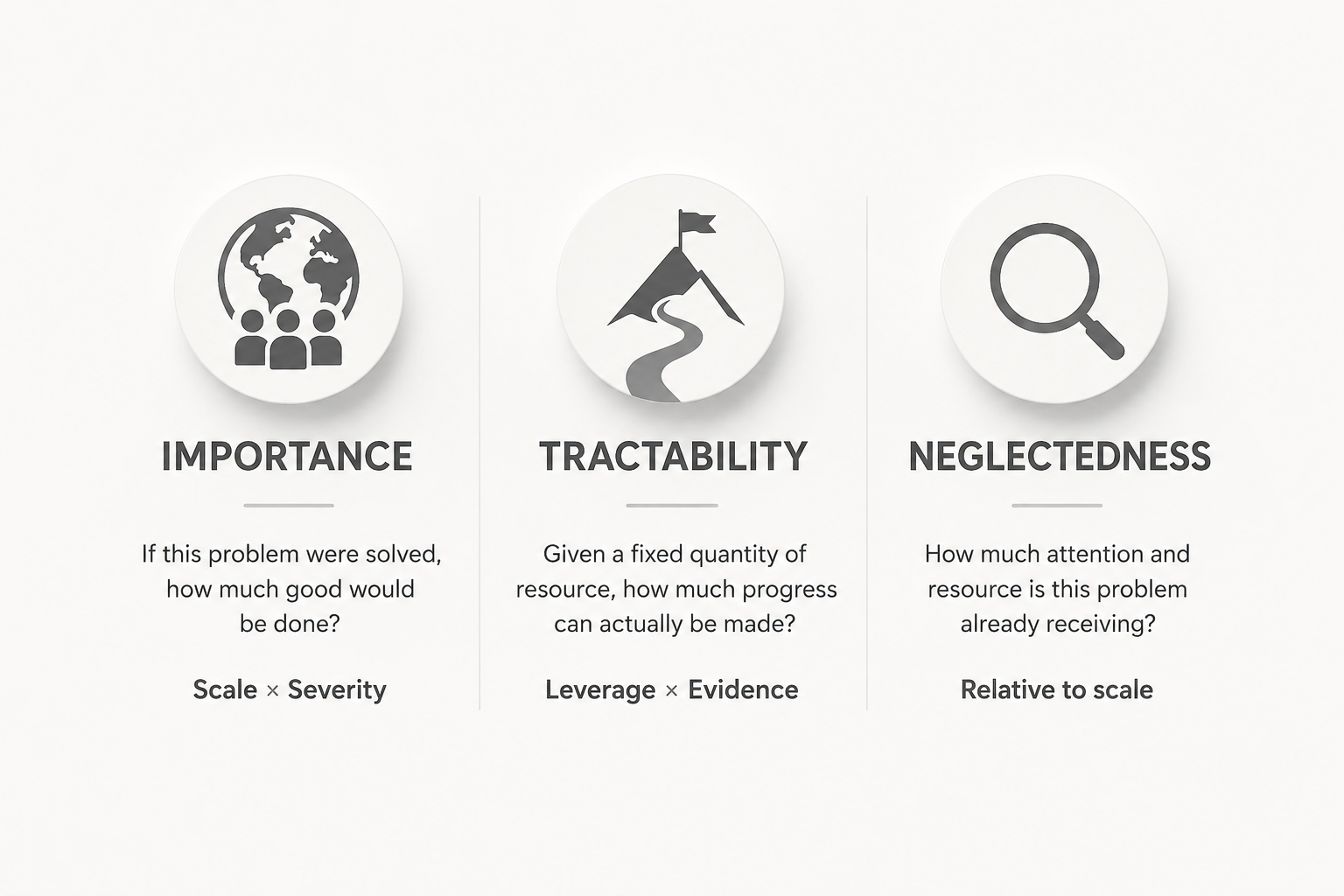
The ITN framework does not produce a single numerical score that resolves cross-cause comparisons. It is a structured way of asking the right questions. Those questions, applied honestly, require comparing values: how much does the suffering of a factory-farmed animal weigh against the suffering of a child with malaria? Those comparisons involve irreducible moral uncertainty (which we will address in one of the upcoming posts). Now, let me explain how I navigate that uncertainty.
Global health
By ITN standards, global health performs well on all three dimensions, and it does so in the cause area where the evidence base is most robust.
The importance case is not in dispute. Disease, malnutrition, and preventable death impose an enormous burden concentrated in the world's poorest populations. The scale is measured in hundreds of millions of affected lives; the severity, across the cluster of interventions that effective giving targets, is high. Around five million children under five die each year globally, the majority from causes that are preventable at low cost. Diarrheal diseases alone kill around 340,000 children annually; pneumonia kills more. Malnutrition compounds both, depressing cognitive development and productivity across entire generations in low-income countries. Malaria alone kills around 600,000 people per year, the majority of them children under five.
Tractability in global health is unusually strong. The interventions that GiveWell and its peers recommend are not hypotheses; they are supported by multiple randomised controlled trials across different geographies and time periods. The cost per DALY averted is measurable, and the measurement is reliable enough to support meaningful cross-charity comparisons.
Neglectedness is the more nuanced dimension. Global health receives substantial philanthropic and government funding, which reduces its neglectedness score relative to some cause areas. But the absolute funding gap between what is needed and what is actually spent remains large, and the marginal value of additional well-directed giving is demonstrably high. GiveWell's continued identification of funding gaps at its top charities serves as a practical test: the saturation point has not been reached.
Global health is where the majority of my giving goes. That weighting reflects not only the ITN framework but a strong moral prior: interventions with a robust evidence base and predictable, near-term outcomes deserve priority over those where the causal chain from donation to impact is longer and harder to verify. I try, first and foremost, to think with my brain and apply reason through any charitable giving. At an emotional level, it is extremely hard not to be moved by the level of global suffering, especially in low- and middle-income countries, and by the fact that many such deaths are still due to preventable diseases. The scale of suffering in the world is indeed immense, despite the massive progress the world has made over the last 50 years.
Longtermism and AI safety
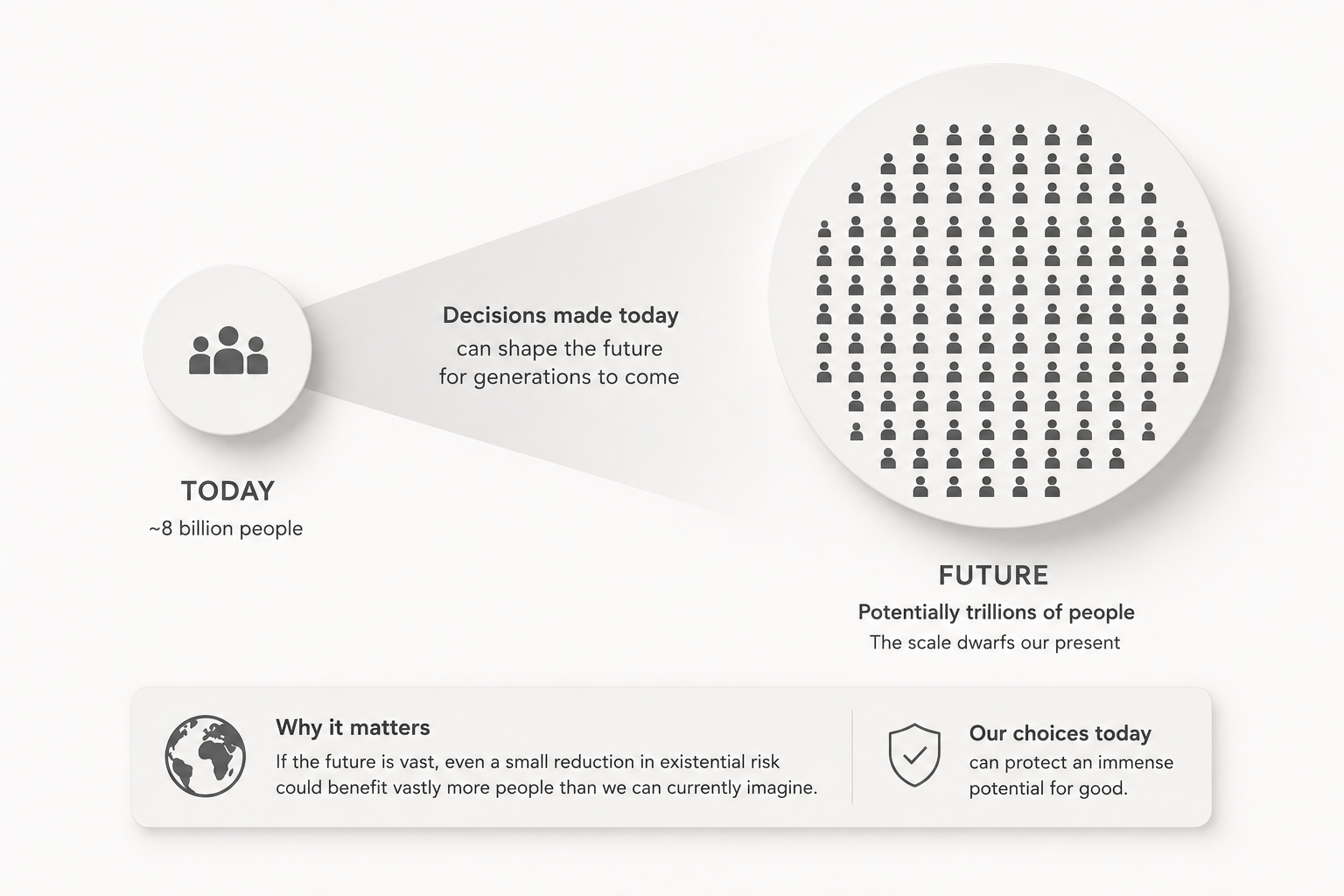
The case for longtermism begins with a straightforward observation. If future generations exist in numbers comparable to current projections, the number of people whose welfare might be affected by decisions made today is orders of magnitude larger than the current global population. Under a utilitarian calculus, even a modest reduction in the probability of a catastrophic outcome (one that forecloses the possibility of those future generations) could justify substantial resource allocation. This line of reasoning can lead to extreme conclusions and spiral quickly into counterfactuals against infinities; the expected-value arithmetic is not easy to dismiss, however.
On the ITN dimensions: importance is potentially very high, on the assumption that the future is astronomically large and that it can be influenced. Neglectedness is also high; the number of researchers working seriously on AI safety, biosecurity, and global catastrophic risk remains small relative to both the potential scale of the problem and the resources available globally. These fields have not attracted institutional attention proportional to what their potential importance might warrant.
Tractability is the dimension where most honest disagreement falls. The causal mechanisms between a donation to an AI safety research organisation and a reduced probability of a catastrophic AI outcome are long, indirect, and genuinely difficult to evaluate. There are no randomised controlled trials. The evidence base is, by the nature of the problem, thin and contested. In addition, given that many of these interventions are about preventing a global catastrophic risk, it is extremely hard to know whether a particular intervention was necessary to prevent a specific civilisation-level risk from happening or whether the same risk would not have materialised for other reasons anyway.
I hold a meaningful allocation to this cause area because I find the importance and neglectedness arguments compelling enough to justify acting under tractability uncertainty. But I hold that allocation with lower confidence than my global health giving, and I would update quickly on evidence that tractability is lower than it currently appears. Moral uncertainty about very long time horizons and large populations is real, and epistemic humility about expected-value reasoning over those scales is warranted. I will admit that my thinking on this continues to evolve, and I might come to different conclusions in the future.
Climate change
The ITN framework applied straightforwardly to climate change produces a result that may surprise anyone who expected effective giving to align with mainstream philanthropic priorities.
Importance is clearly very high. The science on anthropogenic climate change is not in question, and the scale of potential harm across human and non-human populations is large.
Tractability is debated but not negligible. Solutions exist in principle; the constraint is deployment speed, political will, and economic transition, not fundamental scientific uncertainty.
The problem is neglectedness. Climate receives more philanthropic attention, government funding, and public discourse than almost any other cause area. Billions flow from foundations, governments, and corporate sustainability programmes. By the logic of the neglectedness dimension, the marginal impact of an additional donor is likely to be low relative to what is possible in cause areas receiving a fraction of that attention.
I am not a climate sceptic in any sense. My uncertainty is not about whether the problem is real or serious. It is about where a marginal donation makes the most difference. My approach is therefore to maintain a smaller allocation to a climate-focused charity (specifically the Clean Air Task Force, which Founders Pledge has rated as among the most cost-effective climate organisations by tonnes of CO₂e avoided) despite the ITN calculus not fully supporting it. This is, in some sense, a deliberate departure from the framework, and I label it honestly. Some causes carry weight that is not fully captured by expected-value reasoning under neglectedness. I am unwilling to reduce my giving to zero in a cause area of this importance purely because it attracts more attention than most. That is a values-driven exception rather than a conclusion the framework produces on its own. In the same vein, despite lower effectiveness by ITN standards, I also continue to give to Cancer Research.
Animal welfare
The scale of suffering in industrial animal agriculture is difficult to take in fully. Over 80 billion land animals are raised and slaughtered under factory farming conditions each year, a figure so large it resists intuition. By any account of sentience that extends moral consideration beyond humans, the welfare costs are enormous. The evidence that vertebrates, and likely many invertebrates, experience pain and distress in meaningful ways is substantial; a 2021 UK government-commissioned review of over 300 studies concluded that decapod crustaceans alone warranted legal protection as sentient beings. For those unfamiliar with the conditions at scale, Dominion, filmed with drones and hidden cameras inside commercial farms and slaughterhouses across Australia, is a difficult but useful corrective.
On the ITN framework: importance is very high on scale alone. Neglectedness is also high; the cause receives relatively little serious philanthropic attention relative to the number of beings affected and the severity of their conditions. Tractability is real and improving: corporate accountability campaigns have achieved meaningful cage-free commitments from major food companies; alternative protein research is advancing; dietary shift programmes have evidence behind them. The causal chains are less direct than in global health, but they are not speculative.
My allocation focuses on factory farming interventions rather than wild animal suffering, guided by Animal Charity Evaluators recommendations. The philosophical case for caring about wild animal suffering is coherent, but the practical tractability of targeting it directly remains very low. Wild animal suffering is morally important; it does not currently meet the tractability threshold. Organisations working to reduce consumption, improve conditions within existing food systems, and accelerate the transition to alternative proteins are where I find the most credible near-term impact.
Animal welfare sits third in my giving in terms of priority. I suspect it is underweighted globally, and possibly in my own portfolio. The moral case is strong, the neglectedness is genuine, and the cause has historically been treated as peripheral to serious philanthropic discussion. That treatment is not well-justified by the evidence.
Navigating across causes
Committing to a cause-area weighting requires making provisional judgements under genuine uncertainty and being willing to revise them. It does mean engaging seriously with the data available and comparing them against one's axiology and willingness to interrogate one's own moral priorities. In this context, I have always found Peter Singer's work clarifying, particularly on practical ethics and the moral consideration of animals.
Global health gets the majority of my giving because the evidence is strongest, the tractability is highest, and the moral case is immediate and legible. Longtermism and AI safety get a meaningful but smaller share because the importance and neglectedness arguments are compelling even where tractability is uncertain. Animal welfare receives a third allocation because the scale and neglectedness are undeniable, and the tractability is improving. Climate receives a smaller allocation that does not fully follow from the ITN framework but reflects a considered departure from it.
What those allocations actually are, in percentage terms and at the level of specific charities, is what the next post covers.
Giving with intention is a five-part series documenting how I think about charitable giving: the framework I use, how I evaluate charities, how I have structured my portfolio across cause areas, and what I have got wrong.